Do you need a permit to reroof in Sumner County, TN? See when one is required, how fees are set and who to call. Questions? Call (615) 647-8320.
Yes, a building permit is legally mandatory for all full roof replacements across Sumner County, Tennessee, whether your property sits inside an incorporated city (Gallatin, Hendersonville, Goodlettsville, White House, Portland) or in unincorporated county jurisdiction. Minor, isolated repairs—such as replacing a small patch of wind-blown shingles or resealing a pipe boot—generally do not require a permit unless structural roof decking or load-bearing rafter framing is altered.
When Do You Legally Need a Roof Permit in Sumner County?
The primary legal trigger for a roofing permit throughout Middle Tennessee is whether the scope constitutes structural restoration and complete replacement versus minor surface maintenance. Under the International Residential Code (IRC) adopted by local municipalities, replacing an entire roofing membrane or altering structural roof decking triggers code compliance verification.
Permit Mandatory (Codes Review & Inspection):
• Complete Tear-Off & Replacement: Stripping existing shingles down to the wood deck and installing a complete new roofing system on any residential or commercial structure.
• Second-Layer Reroofing / Recovers: Installing a second layer of shingles over existing shingles, or recovering a commercial low-slope roof (subject to the two-layer maximum under IRC Section R908 / IBC Section 1511).
• Decking & Framing Alterations: Re-sheathing large sections of deteriorated plywood, replacing spaced 1x6 tongue-and-groove planks, or repairing load-bearing rafters and engineered roof trusses.
• Pitch or Architectural Conversions: Modifying the roof slope, adding dormers, skylight cutouts, or altering exterior rooflines during home remodeling.
Permit Generally Exempt (Minor Maintenance):
• Isolated Shingle Repairs: Replacing a handful of storm-blown shingles (typically under 100 square feet) where the surrounding roof plane remains undisturbed.
• Pipe Boot Replacements: Swapping out cracked or deteriorated neoprene vent pipe collars on plumbing exhaust stacks.
• Flashing Reseals & Minor Repairs: Resealing step flashing or chimney counter flashing with polyurethane roofing sealant without disturbing the underlying deck.
• Gutters & Downspouts: Installing new 6-inch seamless aluminum gutters, leaf guards, or downspouts that mount to fascia boards without altering the roof drip edge.
"Usually" is doing real work when evaluating repairs. If severe wind or hail damages most of an individual directional roof slope, building officials may consider the repair extensive enough to require a building permit. When in doubt, a reputable contractor verifies the threshold with your local permitting office before work begins.
 Municipal Code Compliance · IRC Inspections
Third-Party Building Code Verification
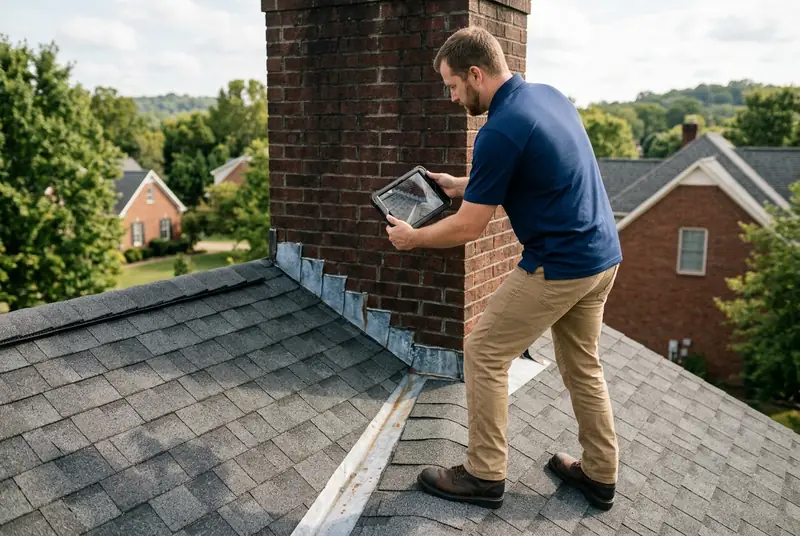
The primary function of a municipal roof permit is independent verification. City inspectors examine underlayment, drip edge metal, ice-and-water barrier placement, and attic ventilation to ensure the installation satisfies adopted IRC building standards before the permit is finalized.
Don't navigate municipal codes or digital filing portals alone. Licensed local contractors handle 100% of the permit paperwork, licensing filings, and final inspections for you.
Which Permit Office Covers Your Specific Sumner County Address?
Sumner County does not maintain a single centralized permitting desk for all properties. Instead, authority is decentralized: each of the five incorporated cities operates its own municipal codes department, while unincorporated rural parcels outside all city limits fall under the Sumner County Building & Codes Department in Gallatin.
Review the complete directory below to identify the exact permitting jurisdiction for your property:
| Jurisdiction | Permitting Department | Adopted Code | Office Address | Direct Phone | Filing Portal |
|---|---|---|---|---|---|
| Hendersonville (Inside City Limits) | Building & Codes Department | Adopted IRC | 101 Maple Drive North, Hendersonville, TN 37075 | (615) 822-3802 | — |
| Gallatin (Inside City Limits) | Building Codes Department | — | 132 W. Main St, Room 202, Gallatin, TN 37066 | (615) 451-5968 | Citizen Self Service (CSS) |
| White House (Inside City Limits) | Planning & Codes Department | — | 105-D College Street, White House, TN 37188 | (615) 672-4350 | whitehousetn.gov |
| Goodlettsville (Inside City Limits) | Codes & Building Safety Department | — | 318 N. Main Street, Goodlettsville, TN 37072 | (615) 851-3741 | GovBuilt Digital Portal |
| Portland (Inside City Limits) | Building Codes Department | Adopted IRC | 100 S. Russell Street, Portland, TN 37148 | (615) 325-6776 | GovWell Digital Portal |
| Unincorporated Sumner County | Sumner County Building & Codes | — | 355 N. Belvedere Drive, Room 208, Gallatin, TN 37066 | (615) 452-1467 | — |
If your physical property is located inside municipal limits, that city's department has sole jurisdiction over your permit—even though the county administration building also sits in Gallatin. If your parcel is outside all five municipal boundaries, the Sumner County Building & Codes Department handles your permit.
How Do Border Cities (Goodlettsville, White House, Portland) Split Permitting Jurisdiction?
Goodlettsville, White House, and Portland each straddle county boundaries. This geographic reality creates confusion among homeowners regarding which office has authority. In Tennessee land-use law, the primary rule is straightforward: municipal incorporation always supersedes county boundaries.
• Goodlettsville (Sumner & Davidson Counties): The City of Goodlettsville's Codes & Building Safety Department issues the municipal building permit across the entire city, on both sides of the county line. That said, county-level requirements still differ by parcel: City of Goodlettsville administers municipal building permits across the city, while Sumner-side parcels follow Sumner County property tax records. Davidson-side parcels instead follow Metro Nashville's own trade code requirements alongside the city's building permit. Explore comprehensive municipal guidelines on our Roof Replacement in Goodlettsville hub.
• White House (Sumner & Robertson Counties): The City of White House Planning & Codes Department at 105-D College Street handles all properties within city limits regardless of county. Outside city limits, jurisdiction divides along the county line: unincorporated Sumner parcels file with Gallatin (355 N. Belvedere Dr), while unincorporated Robertson County parcels outside municipal limits file with the local Robertson County building department. For local details, view our Roof Replacement in White House guide.
• Portland (Sumner & Robertson Counties): Following the identical legal principle, the City of Portland Building Codes Department permits all reroofing within city boundaries. Unincorporated parcels north or west outside city limits route to their respective county office.
Why Your Postal Mailing Address Doesn't Determine Your Permit Office
Postal ZIP codes are designed for mail delivery efficiency by the United States Postal Service and frequently cross municipal and county lines. A home with a "Goodlettsville, TN 37072" or "White House, TN 37188" mailing address might physically sit in unincorporated Sumner County, unincorporated Robertson County, or inside municipal limits.
Licensed roofing contractors verify your official parcel identification number on the Sumner County GIS property map prior to filing. This ensures permit fees and inspection requests are routed to the proper agency without project delays.
What Are the Legal and Financial Risks of an Unpermitted Roof in Sumner County?
Some homeowners wonder if skipping a permit saves time or money. In reality, failing to pull a required building permit introduces substantial legal liabilities, insurance complications, and financial penalties:
- Real Estate Sale & Refinancing Obstacles: When selling your home, buyer home inspectors and title attorneys examine municipal permit records. If a recent full roof replacement has no record of a permit or passed final inspection, buyer lenders can refuse mortgage underwriting until retroactive permits and structural engineering certifications are acquired at high out-of-pocket expense.
- Homeowners Insurance Claim Complications: If your roof sustains severe hail or wind damage during a Middle Tennessee storm, property insurance adjusters inspect past permit filings. If the existing roof was installed without code verification, carriers may contest coverage or hold back recoverable depreciation. Review policy details in our Storm Damage & Insurance Claims guide.
- Absence of Independent Code Oversight: Without a final municipal inspection, homeowners have no independent third-party confirmation that the contractor installed mandatory drip edge metal, ASTM D1970 ice-and-water barrier in valleys, or verified decking nail spacing.
- Municipal Stop-Work Orders & Penalty Fines: Municipal code enforcement officers routinely inspect neighborhoods after major storm events. If an unpermitted tear-off is discovered in progress, a stop-work order is posted immediately. The project is halted, municipalities can impose stop-work orders or added administrative penalties for unpermitted work, and your home remains exposed beneath temporary tarps until paperwork clears.
Tennessee Licensing & HOA CovenantsContractor Licensing & Architectural Oversight
Tennessee law mandates that roofing projects over $25,000 must be executed by Tennessee-licensed contractor (such as BC, BC-A, or BC-21)s. In master-planned communities like Durham Farms, Foxland Harbor, or Twelve Stones Crossing, HOA architectural approvals operate alongside municipal building permits.
How Does the Sumner County Roof Permitting Process Work Step-by-Step?
When you hire an established, licensed roofing contractor, the permitting workflow is handled completely on your behalf. Here is how the sequence unfolds from initial scoping to final sign-off:
- Parcel Jurisdiction & Code Scoping: Your contractor confirms your parcel's physical boundaries via GIS mapping, determining the applicable building code (the adopted International Residential Code) and local wind-uplift specifications.
- Contractor Credential Verification: Tennessee state law requires an active Tennessee contractor license for any roofing project of $25,000 or more, registered with the Tennessee Board for Licensing Contractors. The contractor submits proof of licensing along with certificates of workers' compensation and general liability insurance to the codes department.
- Digital Application & Fee Payment: The permit application is submitted through the jurisdiction's designated digital portal (such as Gallatin's CSS, Goodlettsville's GovBuilt, or Portland's GovWell). Permit fees are paid directly to the municipality.
- Installation & Final Code Inspection: Once the permit is approved, tear-off and installation proceed under manufacturer specifications. Upon completion, the contractor coordinates a final building inspection. The city building inspector inspects drip edge overlap, valley lining, flashing collars, and ventilation, officially closing the permit and generating your Certificate of Completion.
To explore installation methods, ventilation engineering, and shingle options, see our comprehensive Roof Replacement guide, or review local details for Gallatin and Hendersonville.
Frequently Asked Questions About Sumner County Roof Permits
Full roof replacements require a building permit across all Sumner County jurisdictions. Small, isolated repairs—such as replacing a bundle of shingles, installing a new pipe boot, or resealing step flashing—generally do not need a permit. However, if a repair involves structural decking over 100 square feet, alters rafter framing, or replaces an entire directional roof plane, building officials classify it as structural work requiring a permit.
When you hire a roofing contractor, the contractor is legally responsible for pulling the permit. Permitting departments require the applicant to show verified Tennessee contractor licensing, local bonding, and active liability and workers' compensation coverage. Homeowners should never pull an "owner-builder" permit for work executed by a hired contractor, as doing so transfers liability and safety responsibilities directly onto the homeowner.
Permit fees vary by jurisdiction and are typically based on the total project cost, so there's no single flat number that applies countywide. Reputable roofing contractors include the actual municipal permit fee, digital filing charges, and inspection coordination directly in their written project estimates, so you see the real number before work starts rather than a generic range.
No. Homeowners Association (HOA) approval is strictly a private covenant agreement and has zero legal standing with municipal building departments. Subdivisions with Architectural Review Committees (such as Durham Farms in Hendersonville, Foxland Harbor in Gallatin, or Twelve Stones Crossing in Goodlettsville) require shingle color and material approvals, but an official building permit from your city or county codes office remains mandatory.
If caught during installation, codes enforcement will issue an immediate stop-work order, and retroactive permit fees are often doubled. Long term, unpermitted work can void manufacturer warranties, jeopardize insurance claims, and stall home sales during buyer title searches. A contractor offering to "skip the permit to save money" is a major warning sign of an unlicensed or uninsured operator.
Insurance carriers withholding recoverable depreciation require a signed municipal building permit and passed final inspection report before releasing the final payout check. Furthermore, if your city enforces updated codes (like continuous drip edge or wood decking overlays under the adopted International Residential Code), your policy's Ordinance & Law endorsement will only pay for those mandatory upgrades if a building inspector officially requires them on the permit.
For additional guidance on navigating local codes, weather hazards, and municipal factors across northern Middle Tennessee, browse our Local Sumner County roofing guides.
Connect with vetted local roofing crews and review local municipal building requirements:
Related Sumner County Roofing Guides: Continue reading How to Vet a Roofing Contractor in Sumner County, TN and Sumner County HOA Roofing Rules & Material Restrictions.