TN Roofing Insurance Guide: How a Tennessee Roof Claim Actually Works
ACV vs. RCV, what your adjuster is actually looking at, how to read your estimate line by line, and what to do when the number that comes back isn't enough to cover the work.
How a Tennessee Homeowners Insurance Roof Claim Actually Works
A homeowners insurance roof claim isn't one event — it's a sequence of documents and decisions, and where the process goes off the rails usually traces back to one of a handful of predictable points: a rushed adjuster meeting, an estimate nobody actually read line by line, or a deductible rule nobody checked before the storm hit. This guide walks the sequence itself. For the broader picture — recognizing storm damage, claim types, and what a contractor can and can't do during a claim — see Storm Damage & Insurance Claims, the hub this guide supports.
Not Insurance, Legal, or Public-Adjusting Advice
This page explains general insurance-claim mechanics for informational purposes. It is not insurance advice, legal advice, or public-adjusting services, and TN Roofing Crew is not a licensed public adjuster or a law firm. Your specific policy language controls your specific claim — confirm terms with your agent or carrier, and consult a licensed public adjuster or an attorney for a disputed or denied claim.
A roof claim moves through the same basic sequence regardless of carrier: a storm damages the roof, the damage gets documented, the claim is filed and an adjuster inspects it, the carrier issues a written estimate with a coverage decision baked into it, the homeowner (often with a contractor) reviews that estimate against what the roof actually needs, repairs happen, and any holdback is released at the end. Each step depends on the one before it — a weak documentation step produces a weak adjuster meeting, which produces an estimate that's harder to correct later.
- Damage occurs and gets documented. Photos, a written inspection report, and a date-stamped record of conditions — see Storm Damage & Insurance Claims for the full documentation checklist this guide doesn't repeat.
- The claim is filed. You contact your carrier directly, provide the date of loss, and receive a claim number.
- The adjuster inspects the property. Either independently or with your contractor present — covered in detail below.
- The carrier issues a written estimate. This document states what's covered, at what price, and whether payment is Actual Cash Value or Replacement Cost Value.
- The estimate gets reviewed. Against the actual scope of damage and against code requirements — this is the step most homeowners skip, and it's where this guide spends the most time.
- Repairs are completed and the file closes. A final invoice and completion documentation trigger any remaining payment.
Two branches can interrupt that sequence at almost any point: the carrier's estimate can come back lower than what the roof actually needs, or a specific line item (a discontinued shingle, a code-required component) can become a standalone dispute. Both are covered later in this guide under what to do if a claim is denied or underpaid.
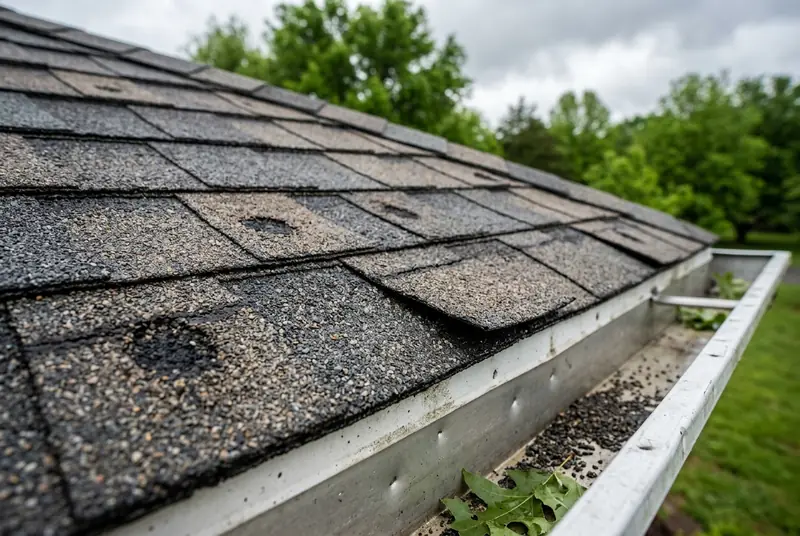
ACV vs. RCV: What the Difference Actually Means for Your Payout
Actual Cash Value (ACV) pays your roof's depreciated value; Replacement Cost Value (RCV) pays the full replacement cost minus your deductible, released in two stages. The difference isn't academic — it changes how much cash you need on hand before the work is even scheduled.
Under an ACV policy, the carrier calculates what your roof was worth immediately before the loss — replacement cost minus depreciation for its age and condition — and pays that amount, period. If your 18-year-old roof would cost $14,000 to replace today but has depreciated by $6,000, your ACV payout is roughly $8,000 minus your deductible. You cover the depreciation gap yourself, whether that means paying out of pocket or choosing a smaller-scope repair.
Under an RCV policy, the carrier pays in two stages. The first payment is typically the ACV-equivalent amount — replacement cost minus depreciation minus your deductible. Once the roof is actually replaced or repaired and you submit the final invoice and receipts, the carrier releases the second payment: the "recoverable depreciation" that was held back. The total across both payments equals full replacement cost minus your deductible — but only if the work gets completed and the paperwork gets submitted. Skip that step and the held-back depreciation stays with the carrier.
| Policy Type | What You Receive Up Front | What Happens After Repairs |
|---|---|---|
| ACV | Replacement cost minus depreciation minus deductible | Nothing further — this is the final payout |
| RCV | Same depreciated amount, minus deductible, as a first payment | Recoverable depreciation released after completed repairs and receipts are submitted |
Figures above are illustrative only, not a quote or estimate for any specific roof. Your actual depreciation schedule, deductible, and payout depend entirely on your carrier and policy.
Check your policy's declarations page to see which type you have — it's usually stated explicitly, and it's worth confirming before a storm, not after one.
Preparing for the Adjuster Meeting
An adjuster's on-site inspection is the single event that most shapes your claim's outcome, because the written estimate that follows is built from what gets observed and measured during that visit. Walking in prepared changes what gets captured.
Have Documentation Ready First
A contractor's written, photo-backed inspection report gives the adjuster a reference point and makes it harder for damage to get missed or dismissed as pre-existing wear.
Ask If Your Contractor Can Attend
A contractor present during the adjuster's walk-through can point out damage by slope in real time and answer scope questions on the spot — this is different from a contractor negotiating your claim, which is outside what a roofing contractor is permitted to do (see what your contractor can and can't do).
Know Your Policy Basics Going In
ACV or RCV, your standard deductible, and whether a separate wind/hail deductible applies — all stated on your declarations page.
Walk Every Slope, Not Just the Obvious One
Hail and wind damage rarely distribute evenly across a roof; an adjuster who only inspects the most visibly damaged slope can undercount the claim.
Point Out Collateral Evidence
Dented gutters, vents, and AC condenser fins corroborate a hail event even where shingle damage is harder to see from the ground.
Take Your Own Photos During the Visit
Not to contradict the adjuster, but to have an independent, date-stamped record of what was actually inspected.
Before You Sign Anything
Ask for a copy of the adjuster's scope before you sign anything — you're not obligated to accept a verbal summary as the final word, the written estimate is what matters. Most adjusters are working through several inspections a day, especially after a widespread storm event. That isn't a reason for suspicion on its own, but it is a reason to be the one who slows the process down enough to make sure nothing gets missed.
Have Someone Walk the Roof With Your Adjuster
TN Roofing Crew connects you with a local, independently licensed and insured contractor who can document your roof before the adjuster's visit and be present during the on-site inspection.
How to Read Your Insurance Estimate Line by Line
Most carriers and contractors generate roofing estimates using standardized estimating software (Xactimate is the most widely used in the industry), which breaks the job into line items — tear-off, underlayment, starter strip, field shingles, ridge cap, flashing, drip edge, pipe boots, ventilation, and cleanup, among others. Reading the estimate means checking whether every component your specific roof needs actually has a line, not just skimming the total at the bottom.
A gap between a contractor's estimate and the carrier's scope of loss is common and isn't automatically evidence of bad faith — measurement differences, waste-factor assumptions, and regional pricing all contribute. But a handful of specific gaps are worth checking for by name:
| What to Check | Why It Gets Missed |
|---|---|
| Missing code-required components | If current building code requires drip edge, ice-and-water shield, or a specific ventilation detail that your existing roof lacks, an initial estimate sometimes omits them. Whether your policy pays for the upgrade depends on your specific coverage (often called ordinance-or-law coverage) and its limits — it isn't automatic. |
| Quantity or measurement discrepancies | Roof squares, linear feet of ridge and valley, and waste-factor percentage all drive the total — a measurement pulled from satellite imagery can miss dormers, chimneys, or complex roof geometry that a physical measurement catches. |
| Overhead and profit (O&P) treatment | Estimating software often includes a line for general contractor overhead and profit, typically applied when a job requires coordinating multiple trades. Whether it's included, and at what rate, depends on your specific loss and your carrier's practices — ask directly if you don't see it and believe the job requires it. |
| Hidden damage found at tear-off | Decking rot, prior water intrusion, or additional storm damage that's only visible once the old roofing is removed. This is the most common trigger for a supplement (see below). |
| Matching for discontinued materials | If your existing shingle's color or profile is no longer manufactured, an exact match on a partial repair may not be possible — whether that justifies a broader replacement depends on your policy's matching language. |
What a Supplement Actually Is
A supplement is a documented request to add legitimately omitted or newly discovered items to an already-approved scope — most often triggered by damage found during tear-off. Your contractor documents the condition and submits supporting photos and pricing; your insurer decides whether to approve it. A contractor can advocate for what the job needs in writing, but it does not have authority to negotiate coverage on your behalf.
If you're comparing your carrier's number against a contractor's proposal for the actual work, see Roof Replacement Cost for what a full tear-off and replacement typically involves, or Roof Repair if the scope is a targeted fix rather than a full replacement.
Tennessee Deductible Rules and Filing Deadlines
Most Tennessee homeowner policies apply a separate, often percentage-based wind/hail deductible — commonly in the range of 1% to 5% of your dwelling coverage limit — rather than the flat dollar amount used for other types of claims. On a home with a $300,000 dwelling coverage limit, a 2% wind/hail deductible works out to $6,000, which is a very different number than the $1,000 flat deductible many homeowners assume applies. Your specific percentage or dollar figure is stated on your policy's declarations page — there is no single statewide number, so check your own policy rather than assuming.
Filing deadlines matter just as much as the deductible amount. Most Tennessee wind/hail claims must be filed within roughly one year of the date of loss, though the exact window is set by your individual policy, not a single fixed rule for every carrier. Once a claim is filed, general Tennessee insurance-practice norms hold that carriers must acknowledge a claim within 30 days, decide to accept or deny it within 60 days of receiving your proof of loss, and pay within 30 days of accepting liability. These are general practice timelines, not a substitute for your policy's own language, and delays can occur for legitimate reasons (a widespread regional storm event, an incomplete proof of loss, or a pending supplement).
Your Deductible Is a Contractual Obligation, Not a Negotiable Discount
What to Do If Your Claim Is Denied or Underpaid
A denial or a lowball estimate isn't necessarily the final word. Tennessee homeowners have two main paths forward, depending on what's actually in dispute: a supplement for specific omitted items, or the appraisal process for a broader disagreement about value.
If Specific Items Were Omitted
A code-required component, damage discovered at tear-off, a measurement error — a supplement request is the direct route.
Your contractor documents the condition with photos and pricing and submits it to the carrier; the carrier reviews and decides whether to approve it. This is the most common and least adversarial way a claim gets corrected.
If the Dispute Is About Overall Value
Your contractor's estimate and the carrier's scope of loss remain far apart after a supplement attempt, or the carrier's per-unit pricing itself seems too low.
Tennessee courts generally enforce the appraisal clause found in most homeowners policies — a structured, three-person process outlined below.
The Appraisal Process, Step by Step
1. Invoke the ClauseIn Writing
You invoke the appraisal clause in writing, as described in your policy, and name your own appraiser.
2. Insurer Names Its AppraiserSeparate Costs
Your insurer names its own appraiser. Each side typically pays for its own appraiser.
3. A Neutral Umpire Is SelectedBy Agreement
The two appraisers select a neutral umpire. If they can't agree on one, a court can appoint one under most policy language.
4. The Panel Decides2 of 3 Binding
The panel evaluates the disputed amount of loss and a decision agreed to by any two of the three (your appraiser, the carrier's appraiser, and the umpire) becomes binding on the amount of loss.
It's important to understand what appraisal does and doesn't resolve: it settles disagreements over how much a covered loss is worth. It does not decide whether something is covered at all — a coverage denial (the carrier saying a loss isn't covered under the policy, not just that it's worth less than claimed) generally falls outside what appraisal can fix, and typically requires a formal dispute, a complaint to the Tennessee Department of Commerce and Insurance, or an attorney.
Matching Disputes, From the Homeowner's Side
If your shingle color or profile is discontinued and a partial repair would leave a visibly mismatched roof, that's a real and common dispute — not a manufactured one. Document the mismatch with photos comparing the existing and available replacement material side by side, and reference your policy's specific language on matching (some policies address "reasonable match," others don't address it explicitly at all). This is exactly the kind of value dispute the appraisal process above is built to resolve when a supplement request alone doesn't settle it.
For a claim that's been denied outright, or where the dollar gap is large enough that appraisal fees and time feel worth it, a licensed public adjuster or an attorney who handles property insurance disputes is worth involving. That is a different professional than the contractor performing your roof work — TN Roofing Crew connects you with the contractor, not with legal or public-adjusting representation, and does not itself negotiate or guarantee your claim's outcome.
Once a dispute resolves — through a supplement, appraisal, or otherwise — the claim rejoins the normal sequence: repairs are completed, a final invoice and completion documentation are submitted, and any RCV holdback is released. See Roof Replacement for what that completed-work stage looks like in practice.
Keep Reading
This guide walks the claims sequence itself — these related guides cover the surrounding decisions.
Storm Damage & Insurance Claims
The hub this guide supports — recognizing storm damage, claim types, and contractor boundaries during a claim.
Cost & PricingRoof Replacement Cost Guide
Compare your carrier's estimate against real installed pricing per roofing square across Sumner County.
Decision GuideRoof Repair vs. Replace Guide
Whether a targeted repair or a full replacement makes more sense for your specific damage.
Insurance Claim FAQ
Direct answers to the questions homeowners ask most often about ACV/RCV, adjuster meetings, and disputed claims.
No. TN Roofing Crew is a referral and marketing service, not a public adjuster or law firm. Your assigned independent contractor can document damage, prepare a written estimate, and attend the adjuster meeting with you, but negotiating coverage or representing you in a dispute is outside what a roofing contractor is licensed to do. A licensed public adjuster or attorney handles that role.
Check your policy's declarations page — it states the coverage type explicitly, usually near the dwelling coverage section. If you can't find it, your agent can confirm it in a short phone call, and it's worth doing before a storm rather than during a claim.
You're not required to agree to anything verbally during the visit. Ask for the written estimate, review it against the actual scope of damage (see the line-by-line section above), and raise specific, documented gaps through a supplement request rather than a general objection.
Yes. Getting an independent contractor's written estimate for comparison is standard practice and doesn't affect your claim negatively on its own. It's the basis for a supplement request if the two estimates reveal a genuine gap.
No — appraisal is a contractual process built into most homeowners policies, resolved by a three-person panel rather than a court, and it only resolves disagreements about the amount of a covered loss. A coverage denial (whether something is covered at all) is a separate issue that appraisal doesn't resolve and may require a formal complaint or an attorney.
Some Tennessee carriers offer premium credits for verified Class 4 installations, but this is carrier- and policy-specific, not automatic or universal. Ask your agent directly whether your specific policy offers one before assuming it applies.
Under an RCV policy, the recoverable depreciation portion is only released once the repair or replacement is actually completed and you submit the final invoice and receipts. If the work is never completed, that second payment generally isn't released — check your specific policy's terms and any time limits it places on completing the work.
Get Your Roof Documented Before You File
A written, photo-backed inspection gives you and your adjuster the same starting point — and it's free, with no obligation to file a claim.
TN Roofing Crew connects property owners with vetted, independently licensed and insured Tennessee roofing contractors. Inspections, repairs, and workmanship warranties are provided directly by the independent licensed contractor assigned to your home. TN Roofing Crew is not a public adjuster, does not adjust or negotiate insurance claims, and does not guarantee any claim outcome.
Guides, Pricing & Local Roofing Articles
- Step-by-Step Post-Hailstorm Checklist for Sumner County →
- Documenting Shingle & Soft-Metal Hail Damage for Claims →
- Tennessee Policy Non-Renewal Rules & Storm Claims →
- Public Adjusters vs. Carrier Adjusters vs. Roofing Contractors →
- Top Mistakes That Void a Roof Insurance Claim in TN →
- Middle Tennessee Hail Season Timeline & Storm Prep →