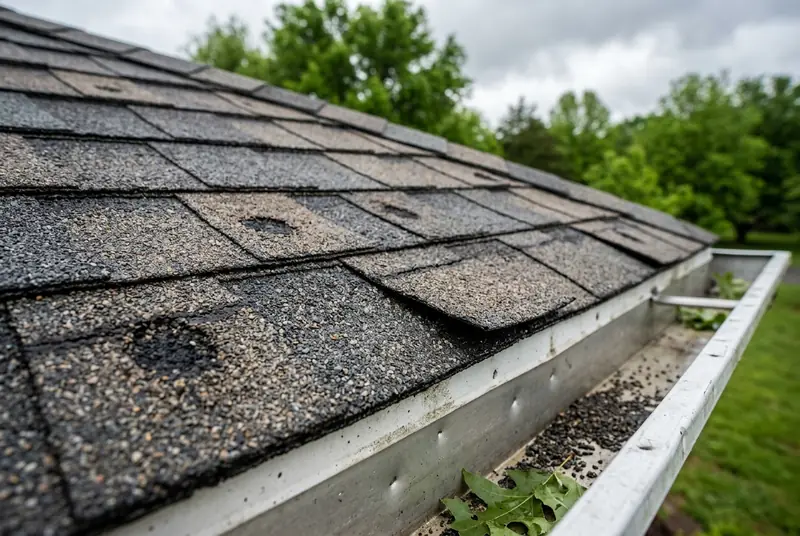
Strong photos and dates make a roof claim easier to prove. Learn what to capture on shingles, gutters and soft metal, then call (615) 647-8320 for a check.
Thoroughly documenting roof storm damage requires presenting traceable, verifiable physical evidence to your insurance carrier. An adjuster-ready storm claim portfolio includes time-stamped photographs of test squares on affected roof planes, close-up photos of fractured shingle asphalt mats, documentation of collateral damage to gutters and air conditioning units, and certified Doppler radar storm history. Providing comprehensive physical evidence prevents claim denials and ensures all code-required items are approved.
Why Objective Physical Evidence is Crucial for Roof Claims
Insurance adjusters operate under strict underwriting and claims handling guidelines. An adjuster cannot approve a full roof replacement based on vague assertions or general photos showing normal shingle aging. They require measurable forensic indicators proving that wind uplift forces or hailstone kinetic impacts directly impaired the roof's physical integrity and water-shedding performance during a covered policy period.
In Middle Tennessee, severe convective storms often produce localized microbursts where one street receives 1.75-inch hail while an adjacent neighborhood experiences only rain. Establishing indisputable proof requires pairing on-roof physical markers with third-party meteorological storm telemetry.
The 4 Pillars of Comprehensive Storm Damage Documentation
A professional roof documentation binder prepared by a licensed roofing contractor encompasses four core categories of evidence:
- 01
Test Square Chalking & Hit Density Counts
Adjusters evaluate hail claims by measuring a 10-foot by 10-foot test square (100 square feet) on each directional slope (North, South, East, West). Using builder's chalk, the roofing inspector circles hail impact bruises that have dislodged granules and fractured the fiberglass backing. Standard carrier approval criteria typically requires 8 to 10 verified hits per test square across multiple slopes.
- 02
Close-Up Macro Photography of Shingle Fractures
The inspector captures high-resolution macro photos showing exposed black bitumen, broken glass fibers, and indentations where kinetic impact crushed the shingle core. For wind claims, the inspector photographs horizontal creases along the tab tops where wind uplift broke the manufacturer's thermal adhesive bond.
- 03
Collateral Metal & Elevation Damage Catalog
Adjusters scrutinize "soft metals" to verify hail size and wind directionality. The inspector photographs dents on aluminum ridge vents, box vents, chimney flashing saddles, aluminum gutters, downspouts, window wraps, and painted siding surfaces.
- 04
Certified Doppler Radar & NOAA Hail History
Contractors corroborate property damage with archived National Weather Service (NWS) Doppler radar telemetry. Certified weather reports document the exact date, timestamp, hailstone diameter, and wind gust velocities that occurred over your specific property address.
Insurance Adjuster Evidence Checklist Matrix
The table below details the specific evidence requirements for major roof components during an insurance inspection:
| Roof Component | Physical Evidence Required | Adjuster Evaluation Metric | Adopted Building Code Mandate |
|---|---|---|---|
| Field Shingles (Hail) | Circular bruises, missing granules, fractured asphalt mat | 8 to 10 verified hits per 100 sq ft test square | IRC R905: Cannot reroof over compromised shingle matrix |
| Shingle Tabs (Wind) | Horizontal crease at tab top, torn adhesive seal | Broken thermal bond causing progressive wind blow-off | ASTM D3161 Class F wind resistance restoration |
| Valley Linings | Punctures, tears, or deep dents in valley metal/membrane | Impaired water flow or puncture threatening interior | IRC R905.2.8.2: 36" ice barrier or 26-ga metal liner |
| Perimeter Drip Edge | Dents from hail or damage incurred during tear-off | Mandatory replacement on full tear-off scopes | IRC R905.2.8.5: Mandatory perimeter drip edge |
| Ridge Vent / Caps | Cracked plastic baffles, dented aluminum, loose cap nails | Functional ventilation failure allowing water intrusion | IRC R906: Balanced net free attic ventilation |
What Role Does Your Roofing Contractor Play During Adjuster Meetings?
Under Tennessee law, roofing contractors are authorized to document physical roof damage, provide itemized repair estimates, and meet your insurance adjuster on-site to inspect physical conditions together. Your contractor provides ladder access, assists in identifying subtle slope damage, and ensures code-required items (such as mandatory drip edge and valley ice barrier) are included in the adjuster's scope of loss.
However, Tennessee law strictly prohibits contractors from acting as public adjusters or negotiating claim settlements unless separately licensed as a Public Adjuster by the Tennessee Department of Commerce and Insurance (TDCI). Our trade partners operate strictly within these legal boundaries, providing defensible physical documentation while leaving policy settlement discussions to you and your carrier.
Forensic Hail Damage vs. Natural Shingle Aging
A common point of dispute during insurance claims is distinguishing legitimate kinetic storm damage from normal age-related shingle wear. Insurance adjusters evaluate physical markers using established engineering guidelines (such as Haag Engineering forensic standards). Legitimate hail damage exhibits localized circular indentations, crushed fiberglass backing fibers, and freshly exposed, unweathered asphalt substrate.
In contrast, natural weathering produces uniform granule thinning across entire slopes, surface crazing (interconnected hairline cracks), and thermal blistering caused by trapped volatile oils or inadequate attic ventilation. Documenting collateral damage on adjacent metal surfaces — such as dented aluminum box vents, dinged air conditioning fins, and chipped paint on window sills — provides indisputable corroborating proof that severe hail occurred at the property.
Adjuster Walkthrough Preparation Checklist
To ensure an efficient, professional on-site roof inspection with your insurance carrier adjuster, prepare the following items in advance:
- Provide Safe Ladder Access: Ensure your roofing contractor supplies professional, OSHA-compliant fiberglass extension ladders and safety gear for steep slope access.
- Organize Prior Roof Documentation: Gather prior home inspection reports, original shingle installation invoices, or historical photos demonstrating roof condition prior to the storm date.
- Compile NOAA Storm Telemetry: Have your contractor provide certified weather radar hail tracking logs confirming the storm date and hail size over your specific parcel coordinates.
- Review Building Code Requirements: Ensure your contractor has local municipal building code references ready to verify mandatory items like perimeter drip edge and valley ice barrier membranes.
Frequently Asked Questions About Documenting Storm Damage
If an initial claim is denied despite documented damage, you have the right to request a reinspection with a different adjuster. Your contractor can attend the reinspection with a complete photographic evidence binder and Doppler radar verification to walk the roof slopes with the secondary adjuster.
Yes. Photographing ground-level collateral damage (dented gutters, broken siding, hail stones beside a ruler) is helpful. However, safety hazards make on-roof photography dangerous for homeowners; allow a licensed, insured roofing contractor to photograph steep roof planes and chalk test squares.
Policy coverage varies. If the existing shingles are discontinued or obsolete and cannot be matched in size, color, or thickness, your contractor can provide manufacturer documentation demonstrating that a partial slope repair compromises roof uniformity and weather-tight performance.
Next Steps & Related Roofing Guides
Related Sumner County Roofing Guides: Continue reading What to Do After a Hailstorm Hits Your Sumner County Roof and Can Insurance Drop You for a Roof Claim in Tennessee?.