Missed deadlines, old damage and deductible waivers can sink a roof claim. Learn the pitfalls before you file, then get a roofer's report: (615) 647-8320.
Under Tennessee property insurance law and standard carrier underwriting terms, a roof storm damage claim can be voided or denied due to missed filing deadlines (typically 365 days from the date of loss), failure to mitigate secondary water damage, committing insurance deductible fraud through illegal contractor rebates, or when damage is determined to stem from pre-existing deferred maintenance rather than a sudden storm peril. Protecting your claim requires objective physical documentation, timely reporting, and avoiding unlawful deductible waiver schemes.
The Primary Triggers That Void Roof Insurance Claims
Homeowners in Sumner County who experience severe convective storms often assume that having active homeowner insurance guarantees automatic claim payment. However, insurance contracts contain specific policyholder obligations, exclusions, and statutory compliance clauses. Failing to adhere to these provisions gives carriers legitimate legal grounds to deny coverage or void a claim entirely:
- 01
Missing the State & Policy Statute of Limitations
Most homeowner policies operating in Tennessee require storm damage to be formally reported within one year (365 days) from the documented storm date. If a homeowner discovers roof hail damage 14 months after a verified storm, the carrier's claims department will routinely issue a formal denial based on late reporting, regardless of how severe the physical damage is.
- 02
Participating in Deductible Waiver Schemes (Insurance Fraud)
Tennessee state law strictly prohibits roofing contractors from waiving, rebating, paying, or absorbing a homeowner's insurance deductible. Contractors who offer "free roofs" or agree to cover deductibles through false invoicing commit insurance fraud under Tennessee law and standard policy contracts. If an insurer discovers a deductible rebate scheme, the claim can be retroactively voided, payment withheld, and the policy canceled.
- 03
Failure to Mitigate Ongoing Water Intrusion
Every standard property insurance policy includes a mandatory "Duties After Loss" clause requiring policyholders to protect property from further damage. If wind blows shingles off your roof and you fail to have an emergency tarp installed, allowing rain to ruin interior ceilings and hardwood flooring over subsequent weeks, the carrier may deny all interior water damage claims due to homeowner neglect.
- 04
Pre-Existing Wear & Deferred Maintenance Exclusions
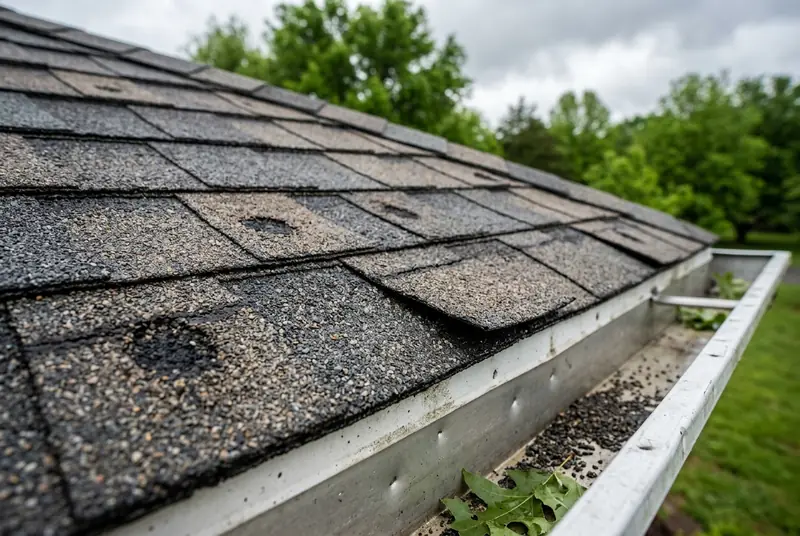
Insurance covers sudden, accidental physical loss — not gradual aging. If an adjuster inspects a 25-year-old roof with widespread granule depletion, rotted fascia, and dried-out pipe boots, the carrier will attribute interior leaks to normal wear, tear, and deterioration, which are explicitly excluded under standard Section I property coverage.
Comparison Matrix: Covered Storm Loss vs. Claim-Voiding Exclusions
The table below illustrates how insurance adjusters distinguish between covered storm perils and excluded conditions across Middle Tennessee:
| Roof Condition / Event | Policy Status | Adjuster Evaluation Criteria | Legal & Practical Outcome |
|---|---|---|---|
| Convective Hail Impact Fractures Fresh hail strikes breaking asphalt mat | Covered Peril | Verifiable impact bruises within 10x10 ft test square | Claim approved for slope or full replacement minus deductible |
| Wind Tab Creases & Lifted Rakes High gusts breaking thermal seal | Covered Peril | Horizontal creases along shingle upper third from wind flutter | Approved under sudden windstorm coverage provision |
| Filing 14 Months After Storm Event Late reporting past policy deadline | Voided / Denied | Exceeds 365-day contractual reporting window | Claim denied for breach of policyholder reporting duty |
| Contractor Invoicing Deductible Rebate "We pay your deductible" scheme | Fraud / Voided | Violation of Tennessee law and carrier contract | Claim voided; potential policy cancellation and legal liability |
| Rotted Decking from Ignored Leak Failure to tarp active leak point | Denied Secondary Loss | Breach of mandatory "Duties After Loss" mitigation | Carrier covers minimal exterior repair; denies interior damage |
| Normal Granule Loss & Shingle Crazing Natural 20-year shingle aging | Excluded Condition | Absence of physical impact depression or fractured fibers | Denied under standard wear, tear, and deterioration exclusion |
Tennessee Contractor Boundaries: Public Adjusting Laws
Another critical legal safeguard involves contractor representation boundaries. Under Tennessee law, roofing contractors are authorized to document physical storm damage, prepare contractor cost estimates, and meet carrier adjusters on-site to inspect physical roof conditions.
However, contractors cannot act as public adjusters or negotiate claim settlements on your behalf unless separately licensed as a Public Adjuster by the Tennessee Department of Commerce and Insurance (TDCI). Hiring an unlicensed contractor who attempts to practice public adjusting can complicate claims and delay settlements.
Sumner County Municipal Building Code Compliance
When an insurance claim is approved, the restoration scope must satisfy local municipal building codes (City of Hendersonville, Gallatin, White House, Goodlettsville, Portland, or Sumner County). These jurisdictions enforce adopted International Residential Code (IRC) standards requiring mandatory perimeter drip edge (IRC R905.2.8.5) and self-adhering polymer ice and water shield in all valleys.
Ensure your contractor provides the carrier adjuster with local building code documentation so that code-mandated upgrades are included in the approved insurance scope under Ordinance or Law coverage endorsements.
Essential Homeowner Best Practices for Claims Integrity
To ensure an insurance claim is processed smoothly without carrier delays or legal disputes, Sumner County property owners should implement these proactive steps:
- Document the Date and Weather Radar Immediately: Retain local storm alerts or National Weather Service hail reports confirming the date and time severe weather struck your neighborhood.
- Request a Physical Contractor Assessment Before Contacting the Insurer: Have an established, licensed local roofer examine test squares on all slopes to confirm that hail impacts have actually fractured the shingle fiberglass matting.
- Avoid Signing Contingency Contracts with Unknown Door-to-Door Canvassers: Never sign an Assignment of Benefits (AOB) agreement or contract committing your entire insurance proceeds before receiving an itemized proposal.
- Ensure Building Permit Costs are Included: Verify that municipal permit fees required by your local building codes department (Hendersonville, Gallatin, White House, or Goodlettsville) are incorporated into the adjuster's final scope of loss.
Frequently Asked Questions About Voided Claims
Yes. If you believe your claim was improperly denied, you can request a reinspection with a different adjuster. Your contractor can attend with photographic evidence and Doppler weather radar history. If a dispute persists, standard homeowner policies include an "Appraisal Clause" allowing an independent umpire panel to resolve scope disagreements.
If a previous owner installed a roof without required municipal permits, an insurer cannot arbitrarily deny a legitimate hail claim unless the unpermitted installation directly caused the loss (e.g., structural collapse from improper fastening). However, pulling permits for your new roof guarantees code compliance and protects future claims.
If an insurer approves replacing only damaged shingles on one slope, but your existing shingles are discontinued and cannot be matched in size or profile without compromising roof weather-tightness, your contractor can submit manufacturer documentation demonstrating that a proper repair requires full slope or total replacement.
Next Steps & Related Roofing Guides
Related Sumner County Roofing Guides: Continue reading What to Do After a Hailstorm Hits Your Sumner County Roof and How to Document Roof Storm Damage for an Insurance Claim.