Asphalt Shingle Roofing in Sumner County, TN
Architectural, 3-tab, premium, and Class 4 impact-resistant shingles — what actually separates one product line from another, and which one fits your roof. TN Roofing Crew connects Sumner County property owners with licensed, insured local roofing crews who install all major shingle lines.
Asphalt Shingle Tiers: 3-Tab, Architectural, Premium & Class 4 Impact-Resistant
"Asphalt shingle" covers a real hierarchy of products, from economy to designer-grade — not one interchangeable material.
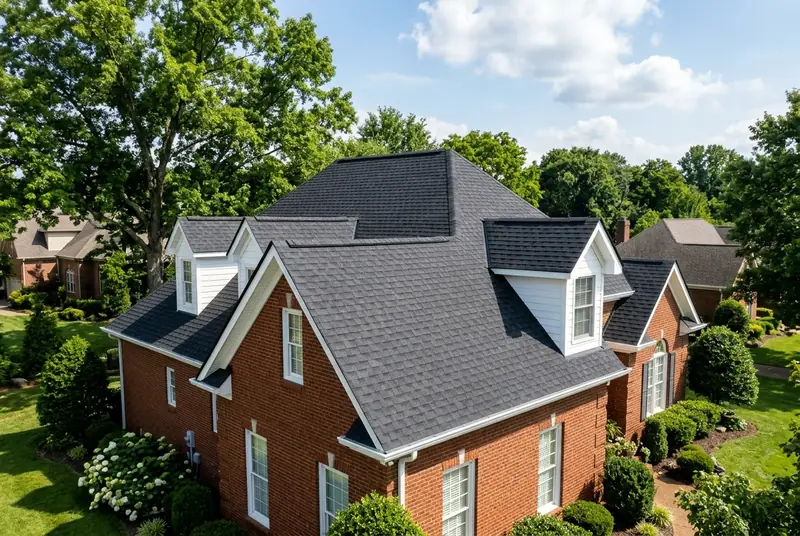
Architectural (Dimensional) Shingles
Multi-layer laminated construction gives these shingles real depth and shadow lines instead of a flat, uniform surface. This is the standard choice for most Sumner County replacements — heavier and longer-lasting than 3-tab, without stepping up to premium/designer pricing.
- Laminated, multi-layer fiberglass mat construction
- Real-world service life commonly cited around 20–30 years, brand-dependent (see brand comparison below)
- The material category covered in detail on this page
3-Tab Shingles
A single-layer, flat-profile shingle — lighter, less expensive, and shorter-lived than architectural. Still installed occasionally on budget-driven projects or to match an existing 3-tab roof, but architectural shingles have become the market standard for a reason: meaningfully better wind performance and longevity for a moderate cost difference.
Premium / Designer Shingles
The heaviest, most dimensional asphalt shingles on the market, often built to visually mimic slate or wood shake. Major manufacturers offer premium or designer-style lines (e.g. CertainTeed's Presidential/Grand Manor-class products) — but the exact profile, color selection, warranty terms, and local distribution vary by product and market, so confirm current availability before assuming a specific line is stocked here. Higher material cost, but the closest asphalt gets to a high-end roofline aesthetic.
Class 4 Impact-Resistant Shingles
A rating, not a product line by itself — UL 2218 Class 4 impact resistance is available as an upgrade within architectural (and some premium) lines from most major manufacturers, using a reinforced mat or rubberized asphalt formulation. The rating applies to the exact tested product variant, not to every shingle in a manufacturer's family — a manufacturer's standard line and its Class 4 upgrade are different products with different testing.
How to Choose the Right Asphalt Shingle Tier
Architectural shingles are the most common choice in Sumner County — but "most common" isn't the same as "automatically correct for your roof." The right tier depends on how these factors combine for your specific property.
A rough starting point based on common situations — a free inspection weighs all of these together against your actual roof, not just the ones below:
Architectural shingles are the right call for most Sumner County homes, but not automatically for every one — a tight budget, an unusual roof geometry, a documented hail history, or an HOA-approved color list can each shift the right answer toward a different tier or product. A free on-roof inspection is the only way to weigh these factors against your actual property.
GAF, Owens Corning & CertainTeed Architectural Lines Compared
The three most common architectural shingle lines installed in Sumner County, and what genuinely separates them.
| Line | Weight (lbs/square) | Algae Warranty | Material Cost/Square* |
|---|---|---|---|
| GAF Timberline HDZ | 220–230 lbs | Up to 25 years | $95–$120 |
| Owens Corning Duration | 215–225 lbs | Around 10 years | $100–$125 |
| CertainTeed Landmark | 230–250 lbs | Varies by tier (Landmark PRO extends coverage) | $110–$140 |
*Material cost per square (100 sq ft) only — not an installed price. Installed project pricing, which includes labor, tear-off, and underlayment, is covered on Roof Replacement.
Documented Attributes, Not a "Best Brand" Ranking
- GAF Timberline HDZ: GAF markets this line's wind warranty and up-to-25-year algae warranty as strengths relative to its own product family — worth confirming against the current published warranty document for the exact product quoted
- Owens Corning Duration: its SureNail fabric reinforcement strip is a technology Owens Corning positions as easing correct high-wind installation — an installation-method claim, not an independent, brand-neutral test result
- CertainTeed Landmark: the heaviest published weight of the three per the table above, which generally correlates with a more dimensional, higher-profile appearance — but "best-looking" is a subjective preference, not a measurable spec
Class 4 Variants of Each
- GAF's standard HDZ is Class 3 impact-rated — the upgraded Timberline UHDZ uses a thicker reinforced mat to reach Class 4
- Owens Corning's Class 4 option is Duration STORM, using a polymeric mesh backing technology
- CertainTeed offers Class 4 options within its impact-resistant product lines — ask your contractor which specific product is being quoted
What to Actually Compare, Factor by Factor
| Wind | Product-specific rating, the nailing pattern actually used, and the warranty conditions tied to that pattern |
| Impact | Confirmed UL 2218 classification for the exact product variant being quoted — not the manufacturer's general family name |
| Algae | Warranty length and any exclusions in the current published warranty document |
| Appearance | Profile depth, color blend availability, and shadow-line style — a preference call, not a ranked spec |
| Weight | Product-specific published weight, relevant to structural load and installation labor |
| Warranty | Standard material coverage versus an enhanced system warranty — see the Installation Specs and Coverage sections below |
| Availability | Current local stocking and whether a specific color or product variant has since been discontinued |
| Cost | Material-only cost per square versus the fully installed project price |
Specs above reflect general, publicly documented manufacturer positioning as of 2026 and are subject to change with product updates, regional availability, and current manufacturer documentation — confirm current specifications, exact product variant, and whether pricing shown is material-only against the specific quote you receive. No manufacturer above is being represented as objectively superior overall — each has genuine, documented strengths in different categories.
Asphalt Shingle Wind & Impact Ratings, Explained
These ratings get quoted constantly and understood rarely — here's what each one actually tests.
UL 2218 Impact Classes
A steel-ball drop test measuring resistance to fracturing. Class 4 is the highest rating — it requires the tested product to withstand a 2-inch-diameter steel ball dropped from 20 feet, twice on the same spot on two separate panels, with no cracking, tearing, or rupture of the backing mat. It's a hail-impact-resistance classification for that exact tested product, not a guarantee against all hail damage on an installed roof.
Wind Ratings (ASTM D3161 / D7158)
Wind resistance is tested and rated separately from impact resistance. A shingle's actual installed wind rating depends on the specific product, the nailing pattern used, and whether it's installed per the manufacturer's high-wind specification — a correctly installed shingle performs to a materially different standard than the same shingle installed with a standard 4-nail pattern in a high-wind zone.
How Asphalt Shingles Fit Into the Full Roof System
A shingle's published spec sheet describes the product. It doesn't describe how the roof actually performs — that depends on the complete assembly underneath and around it.
The field shingles get most of the attention because they're what's visible, but they're one piece of a system that has to work together: the decking provides the structural surface, underlayment and ice-and-water protection are the actual waterproofing layer underneath the shingles, drip edge and starter strip control water at the eaves and rakes, valleys and flashing manage the highest-risk water paths, and ridge vent paired with soffit intake manages heat and moisture in the attic below. A premium shingle over a compromised or mismatched system underperforms a standard shingle installed correctly over a sound one.
This page focuses on the shingle itself — product tiers, ratings, and selection. For the full tear-off process, decking assessment, and system-level warranty structure, see Roof Replacement.
Algae-Resistant Shingle Granules for Middle Tennessee Humidity
The dark streaking that shows up on north-facing, shaded roof slopes over time is typically Gloeocapsa magma, an airborne algae that thrives in humid climates like Middle Tennessee's. It's cosmetic, not structural, but it's also avoidable: algae-resistant shingles embed copper or zinc granules that inhibit growth over the life of the roof.
- Algae-resistance is a distinct product attribute from wind rating or impact class — confirm it's included in the specific shingle being quoted
- Algae warranty length varies significantly by manufacturer and line — see the brand comparison above
- Shaded, north-facing slopes, roofs near mature tree canopy, and properties close to Old Hickory Lake's higher humidity are the most affected
- Algae-resistant granules address the visible streaking, but they don't address attic moisture — that's a separate, ventilation-driven issue (below)
Ventilation Matters More Than Shingle Color
Solar exposure, attic ventilation, insulation, and air leakage interact to determine attic heat and moisture — and shingle choice alone doesn't control that relationship. A balanced system needs soffit intake at the eaves and ridge exhaust at the top working together; if intake is blocked (by insulation, paint, or debris) or missing, ridge exhaust alone can't move air effectively, and the attic can trap heat and moisture. Poorly vented bathroom or kitchen exhaust fans venting into the attic instead of outside add to that moisture load, which can contribute to condensation issues independent of the roofing material itself.
Choosing an Asphalt Shingle Color & Profile in Sumner County
Color and profile decisions run into two things homeowners don't always expect: local approval requirements, and the reality of matching an older roof.
HOA Architectural Review
Many Sumner County subdivisions — including several master-planned communities near Old Hickory Lake — have architectural review committees that pre-approve specific shingle colors and profiles. Confirm your neighborhood's approved list before finalizing a color choice.
Roof Geometry & Resale
A heavier, more dimensional profile reads differently on a simple gable roof than on a complex roofline with multiple valleys and dormers common on older Sumner County homes. Buyers and appraisers also generally view a well-matched, well-maintained roofline favorably at resale.
Historic & Rural Properties
Older homes with complex roof geometry and rural properties with detached accessory structures (barns, workshops, detached garages) sometimes need to match an existing roof across multiple structures — worth flagging before ordering material.
Matching an Existing Roof for a Partial Repair
Why an Exact Match Isn't Always Possible
Shingles weather and change color over time from UV exposure and granule loss, so even the same product ordered new can look slightly different from what's already on the roof. Manufacturers also periodically discontinue specific color blends and even entire product lines — if your existing shingle has been discontinued, an exact match may not be available at any price.
Functional vs. Visual Compatibility
A replacement shingle can be functionally compatible (same weight class, similar nailing pattern) without being a true visual match. Surrounding shingles on an older roof can also be brittle enough that tying in new material disturbs or cracks them — the final call on whether a spot repair, a slope-wide replacement, or a full roof replacement makes sense depends on roof age, material condition, and what's actually available. See Roof Repair for the detailed repair process.
Asphalt Shingle Installation Specs That Affect Your Warranty
A premium shingle installed to a minimum-code standard performs like a mid-tier shingle. A few specifics worth knowing:
Nailing Pattern & Fastening
Most shingles are rated for a standard wind speed with a 4-nail pattern, and a higher wind speed with a 6-nail pattern. The nailing pattern used directly determines which wind warranty actually applies. Nail placement and depth matter too: nails driven outside the manufacturer's specified zone can reduce wind resistance and expose the fastener to weather, while overdriven nails cut into the shingle (weakening holding power) and underdriven nails sit proud, both of which can lead to blow-off or leaks. Ask which pattern is specified for your project, not just which shingle.
Starter Strip, Overlap & Hip/Ridge Compatibility
Enhanced manufacturer warranties typically require a complete system — matched starter strip, field shingle, and hip/ridge cap products from the same manufacturer, not mixed components. A missing or incorrect starter strip can compromise wind resistance right at the eaves and rakes; incorrect shingle overlap and exposure can leave gaps that expose the underlayment to weather sooner than intended.
A valley that concentrates runoff without proper treatment can fail prematurely regardless of the shingle installed over it. Flashing that isn't properly integrated at walls, chimneys, and other penetrations can cause leaks even when the shingles themselves are undamaged. And an intake/exhaust imbalance can undermine ridge ventilation even with correctly installed shingles above it — see the Algae & Ventilation section above. These are installation and system details, not shingle-product attributes, but they determine whether the shingle you chose actually performs the way its rating suggests.
Warranty Types, Kept Separate
"Warranty" isn't one thing — several distinct coverages apply to the same roof, and the issued warranty document for your specific product and installer controls over any general description on this page:
Matched starter, field, and hip/ridge products may be required to qualify for a manufacturer's enhanced/system-level warranty — but exact requirements vary by manufacturer and tier, a matched system doesn't automatically qualify without following the approved installation method, and some tiers require installer certification or product registration within a set window. Transferability to a future homeowner and algae-warranty terms also vary independently of the base material warranty. See Roof Replacement for the full breakdown of standard-material versus enhanced-system versus contractor-workmanship coverage.
Roof Slope & Geometry Considerations for Asphalt Shingles
Product selection can be affected by the roof's actual shape and pitch, not just its size.
Minimum Slope & Underlayment
Per the International Residential Code (IRC Section R905.2.2), asphalt shingles are only permitted on roof slopes of 2:12 or steeper. Slopes between 2:12 and 4:12 require a double layer of underlayment; slopes of 4:12 or greater require only a single layer. Low-slope sections below 2:12 need a different roofing material entirely — not an asphalt-shingle installation detail, a hard material limitation.
Complex Geometry
Multiple valleys, dormers, skylights, and chimney penetrations increase the number of flashing and transition details on the roof — each one is a place water can find a path in if not integrated correctly, regardless of shingle quality. Homes with this kind of roofline (common on older, more architecturally detailed Sumner County houses) generally warrant closer attention to installation detail than a simple gable roof.
How to Compare an Asphalt Shingle Proposal
Two quotes that look similar on price can differ significantly in scope. A complete proposal should specify:
Product & Material Specifics
- Exact manufacturer and product name (not just "architectural shingle")
- Product variant, color, and whether it's currently in production
- Impact classification and wind rating for that specific variant
- Starter strip, hip/ridge cap, and whether they're matched to the field shingle
- Underlayment type and drip edge specification
- Valley treatment and full flashing scope
Scope, Warranty & Schedule
- Ventilation scope (intake, exhaust, any changes to existing vents)
- Tear-off assumptions and decking-repair allowance
- Disposal and cleanup included in the price
- Whether labor is itemized separately from material
- Warranty tier, registration requirements, and stated exclusions
- Material availability and estimated schedule
A proposal missing several of these isn't necessarily dishonest — but it's incomplete, and incomplete scope is the most common source of disputes after the work starts. A free inspection from TN Roofing Crew's partner crews includes a written scope covering these points.
What This Asphalt Shingle Page Covers — and What It Doesn't
Covered on This Page
- Shingle tiers, what separates them, and how to choose between them
- Brand/product-line comparison and material cost per square
- Wind/impact ratings, algae and ventilation, color, matching, and slope/geometry fit
- Installation details that affect real-world performance, and how to compare a proposal
Covered Elsewhere
- Full installed pricing, the tear-off process, and the 3-tier warranty structure (GAF Golden Pledge, CertainTeed SureStart PLUS, etc.) — see Roof Replacement
- Standing seam metal as an alternative material — see Metal Roofing
- Matching shingles for a partial repair — see Roof Repair
- Hail/wind damage documentation — see Storm Damage & Insurance Claims
Related Roofing Services
Asphalt Shingle FAQs
3-tab is a single, flat layer; architectural is laminated multiple layers for a dimensional look, and generally performs better in wind and lasts longer. Most manufacturers have scaled back 3-tab production in favor of architectural lines.
Each has genuine strengths rather than one being categorically better — GAF Timberline HDZ for wind/algae warranty strength, Owens Corning Duration for installation forgiveness, CertainTeed Landmark for weight and premium appearance. See the brand comparison above.
No. Class 4 is the highest UL 2218 impact rating, meaning the shingle resisted a standardized steel-ball drop test better than lower classes — it significantly reduces the odds of fracturing, but it isn't a guarantee against all hail damage.
Both are Class 4 impact-rated versions of a manufacturer's standard architectural line — GAF's standard Timberline HDZ is Class 3, and the upgraded Timberline UHDZ uses a thicker reinforced mat to reach Class 4. Owens Corning's Class 4 option, Duration STORM, uses a different reinforcement approach. Ask specifically which product is being quoted.
Algae resistance depends on the specific copper or zinc granule technology each manufacturer uses, and coverage terms are set independently from wind or impact warranties. Confirm the algae warranty length for the specific product being quoted rather than assuming it matches the shingle's general warranty.
For the enhanced/system-level manufacturer warranties, generally yes — those require a complete matched system (starter strip, field shingle, hip/ridge cap) from one manufacturer. Mixing components can affect warranty eligibility. See Roof Replacement for the full warranty-tier explanation.
Material alone commonly runs $95–$140 per square depending on the line, before labor, tear-off, underlayment, and other installed-project costs. See the brand comparison table above for line-by-line figures, and Roof Replacement for full installed project pricing.
No — they're the common choice for most properties, but budget, roof geometry, hail history, HOA requirements, and repair/matching needs can each shift the right answer toward 3-tab, premium, or a Class 4 upgrade. See "How to Choose the Right Asphalt Shingle Tier" above.
No. Some Tennessee carriers offer premium credits for verified Class 4 installations, but this is carrier- and policy-specific, not automatic. Confirm current eligibility directly with your insurance carrier before assuming a discount applies.
Per IRC Section R905.2.2, asphalt shingles require a minimum slope of 2:12. Slopes between 2:12 and 4:12 need a double layer of underlayment; slopes of 4:12 or steeper need only a single layer. Slopes below 2:12 require a different roofing material entirely.
Exact manufacturer and product, color, impact/wind rating, starter and hip/ridge specification, underlayment, valley and flashing scope, ventilation, tear-off and disposal terms, labor, warranty and registration requirements, and estimated schedule. See "How to Compare an Asphalt Shingle Proposal" above.
A material warranty (from the manufacturer) covers factory defects in the shingle itself. A contractor workmanship warranty (from your installer) covers installation errors like flashing leaks or improper nailing, separately from the material. An enhanced/system warranty is a distinct, manufacturer-issued upgrade with its own requirements. See Roof Replacement for the full breakdown.
On an older roof, surrounding shingles can be brittle enough that tying in new material cracks or disturbs them. When that happens, a targeted repair may need to expand to a wider area, or a full replacement may be the more practical option — your inspector will flag this before starting work. See Roof Repair for the detailed process.
See Asphalt Shingle Samples on Your Own Roof
A free inspection includes a conversation about which shingle tier and brand actually fits your roof, budget, and HOA requirements.
TN Roofing Crew connects property owners with vetted, independently licensed and insured Tennessee roofing contractors. Material selection, installation, and warranties are handled directly by the independent contractor assigned to your project.
Request a Free Inspection
Tell us about your roof and your assigned roofing specialist will bring relevant samples to the inspection.