Storm Damage & Insurance Claims in Sumner County, TN
Hail and wind damage documented, the claim filed correctly, and your adjuster met on-site. TN Roofing Crew connects Sumner County property owners with licensed, insured local roofing crews who handle storm damage from the first inspection through the final repair.
Signs Your Roof Has Storm Damage
Most storm damage isn't obvious from the ground — these are the marks a documented inspection looks for.
Granule Loss & Bruised Shingle Mats
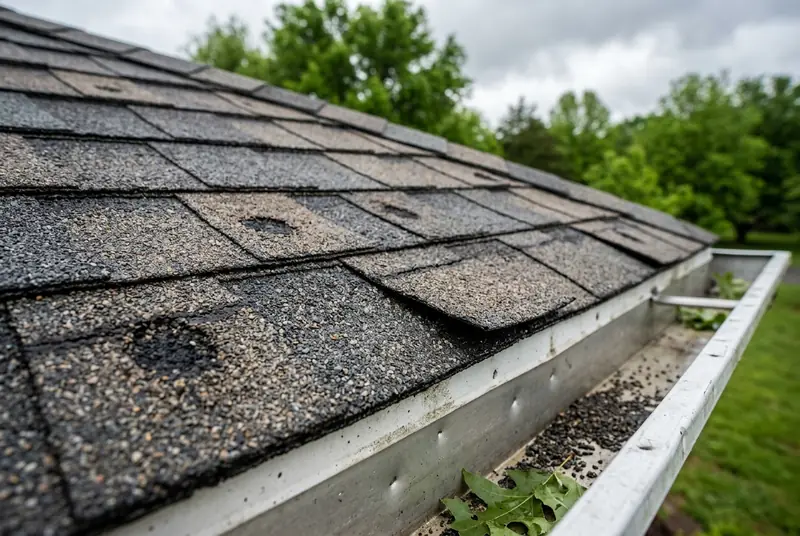
Hail crushes protective granules into the asphalt and can bruise the fiberglass mat underneath without immediately puncturing it — damage that's easy to miss from the ground.
Missing or Creased Shingles
Straight-line wind and tornado outflow break the sealant strip and lift or crease tabs, especially along ridges and rake edges.
Dented Gutters, Vents & AC Fins
Soft aluminum and copper dent more easily than shingles, which is exactly why adjusters treat gutter, downspout, and HVAC fin damage as corroborating evidence of a hail event.
Ceiling Stains or Attic Leaks After a Storm
A stain that shows up in the days after a storm usually means wind or hail already compromised the roof's water barrier somewhere above it.
Fallen Limbs or Debris Impact
Even a glancing branch strike can crack shingles, dent flashing, or displace a ridge cap in a way that isn't visible until it leaks.
Not every storm mark is a claimable loss, and not every claimable loss is obvious — that distinction is exactly what a free, documented inspection is for. If your roof also just needs a repair unrelated to a specific storm, see Roof Repair.
Hail Damage, Wind Damage & Emergency Tarping
Middle Tennessee's storm season drives a large share of roof inspection requests — and each type of damage gets documented differently.
A regional weather report only establishes that a storm passed through the area on a given date — it doesn't, by itself, prove your specific roof was damaged. Reported hail size, wind gusts, and storm direction are useful context, but the physical, on-site inspection is what actually connects a storm event to property-specific damage.
Hail Damage Claims
The National Severe Storms Laboratory treats quarter-sized hail (1 inch) as the general threshold for damaging storms; golf ball-sized hail (1.75 inches) is likely to puncture or crack even a 30-year architectural shingle. Older roofs are more vulnerable — on a roof past 15 years old, even nickel-sized hail can cause claimable damage.
- Granule loss and mat bruising documented slope by slope
- Collateral soft-metal damage (gutters, vents, AC fins) photographed as corroborating evidence
- Roof age factored in, since older shingles are damaged by smaller hail
Wind Damage Claims
Sumner County sits in an active severe weather corridor — the county recorded 8 tornadoes in 2021 alone, its most active year on record, as part of 45 total tornado events tracked since 1950. Wind damage tends to concentrate at ridges, rake edges, and any slope facing the direction the storm came from.
- Missing, lifted, or creased shingles mapped by slope and direction
- Sealant-strip failure distinguished from simple age-related wear
- Fallen-limb and debris impact documented separately from wind uplift
Emergency Tarping & Mitigation
Most homeowner policies require you to take reasonable steps to prevent further damage after a covered loss. A temporary tarp over an active leak protects the interior of the home while the claim is documented and processed — it isn't the repair itself.
- Priority dispatch for active water intrusion, electrical hazards, or an unstable ceiling
- Photographed before and after — if it's safe to do so, photograph the damage before any temporary work begins
- Reasonable mitigation costs (tarping, water extraction) are often reimbursable — keep every receipt
- A fallen tree or visibly unstable structure is a safety issue first — get clear of the area and call for emergency response before worrying about documentation
How Storm Damage Is Actually Documented
An adjuster works from what's on paper. The strength of your claim depends on what was documented before that meeting, not just what happened on the roof.
On-Site Damage Mapping
Each roof slope is inspected and marked separately — hail impact isn't uniform across a roof, and a claim scoped by slope holds up better than a general description.
Collateral Evidence
Gutters, downspouts, vents, and AC condenser fins are photographed alongside the roof — corroborating soft-metal damage is what adjusters look for to confirm a hail event actually occurred.
Date-Stamped Written Report
A written, photo-documented report becomes part of your claim file and is what your adjuster and, if needed, an appraiser will reference.
If the inspection shows the damage doesn't meet a claimable threshold, that's the honest answer — not a reason to file anyway. See Free Roof Inspection for a no-storm-required version of this same documented process.
Functional vs. Cosmetic Damage
- Functional damage affects the roof's ability to shed water — cracked or missing shingle mats, exposed underlayment, compromised seals.
- Cosmetic damage affects appearance without affecting performance — some dented soft metal, minor surface marking on certain materials.
Why This Distinction Matters
- Some policies contain cosmetic-damage exclusions, particularly for certain metal components — whether one applies to your loss depends entirely on your policy language.
- A physical inspection documents what's actually there. It does not determine coverage — that's your carrier's decision under your specific policy.
The Storm Damage Claims Process
Most Tennessee homeowner policies give you roughly a year from the date of loss to file — but the sooner damage is documented, the stronger the claim.
Free Storm Damage Inspection
A specialist walks the roof, documents damage slope by slope with photos, and gives you a straight answer on whether it looks claim-worthy.
File the Claim & Meet Your Adjuster
You (or your contractor, with your authorization) file with your carrier. A specialist can meet your adjuster on-site so nothing gets missed during the inspection.
Scope & Settlement Agreement
Your carrier issues a scope of loss and payment based on your policy's terms — ACV or RCV, minus your deductible. See how that actually works below.
Repair or Replacement Dispatch
Depending on the approved scope, a licensed local crew completes the repair or full replacement — see Roof Repair or Roof Replacement for how each process works.
Final Walkthrough & Depreciation Release
A final invoice, completion photos, and (for a full replacement) a certificate of completion close out the job. If your policy holds back recoverable depreciation, that final payment is typically released once your carrier receives this documentation. Manufacturer warranty registration and your contractor's workmanship warranty are provided at the same time.
Documents You May Encounter
A storm claim generates more paperwork than most homeowners expect. Here's what each piece actually is.
Contractor Estimate vs. Carrier Scope
It's common for a contractor's estimate and the carrier's scope of loss to come in different — that gap doesn't automatically mean the insurer underpaid. Legitimate reasons include:
- Differences in measurements, quantities, or waste-factor assumptions
- Accessories or code-required components (drip edge, ice-and-water shield) omitted from an initial scope
- Local material pricing, labor assumptions, or permit costs not initially accounted for
- Hidden damage that's only discoverable once tear-off begins
Supplements
A supplement is a request to add previously omitted or newly discovered items to an already-approved scope — most often triggered by damage found during tear-off. Your contractor documents the construction scope and submits supporting photos and pricing; your insurer decides whether to approve it under your policy. A contractor documents conditions — it doesn't negotiate coverage on your behalf.
Mortgage-Company Involvement
If you have a mortgage, your insurer often makes the claim check payable to both you and your lender. The lender may require an endorsement before you can cash it, release funds in draws tied to progress inspections, and ask for completion evidence before releasing the final amount. Ask your lender directly about their specific process.
Code Upgrades & Ordinance-or-Law Coverage
Current code may require components your existing roof doesn't have — certain drip edge, underlayment, or ventilation details. Whether your policy pays for those upgrades depends entirely on your specific coverage (often called "ordinance or law" coverage) and your policy's limits. It is not automatic, and we don't assume it applies to your policy.
Discontinued Materials & Matching
If your existing shingle color or profile has been discontinued, an exact match may not be possible on a partial repair. Whether that justifies a broader replacement is fact-specific — it depends on your policy's matching language and is typically resolved through your adjuster or, if needed, the appraisal process rather than a blanket rule.
What Your Contractor Can — and Can't — Do
A roofing contractor and an insurance adjuster play genuinely different roles. Here's where the line sits.
What a Contractor Can Do
- Inspect and physically document roof and exterior conditions
- Prepare a written construction estimate for repair or replacement
- Attend your adjuster's on-site inspection and answer questions about the proposed scope
- Submit supporting photos and documentation if a supplement is warranted
What a Contractor Cannot Do
- Interpret your policy's coverage terms or guarantee what will be paid
- Negotiate your claim as a licensed public adjuster would
- Legally represent you in a dispute with your insurer
- Provide legal advice about your policy or claim
For a claim that's been denied or significantly disputed, a licensed public adjuster or an attorney who handles property insurance disputes may be worth involving — that's a different professional than the contractor performing the roof work.
How Your Claim Payout Actually Works
General policy mechanics — your specific numbers depend on your carrier and policy, not a standard formula.
Actual Cash Value (ACV) Policies
Depreciated payoutReplacement Cost Value (RCV) Policies
Two-stage paymentWind/Hail Deductible
Often percentage-based in TNNone of this replaces your policy's actual language. See the full TN Roofing Insurance Guide for a deeper walkthrough, and confirm your specific terms with your agent.
Tennessee Response Timelines
Under Tennessee's prompt-payment rules, insurers generally must acknowledge a claim within 30 days, notify you within 60 days whether it's accepted or denied once they have your proof of loss (with 60-day renewal notices if more time is needed), and pay within 30 days of accepting liability.
Filing Deadlines
Most Tennessee wind/hail claims must be filed within about a year of the storm date, though the exact window depends on your policy. A sworn proof of loss, when requested, is commonly due within 60 days. File promptly and check your own policy language.
What This Service Covers — and What It Doesn't
Assigned local roofing contractors help document physical storm damage for your claim. Your insurance company decides coverage.
What We Help With
- Documenting hail and wind damage with a written, photo-backed report
- Meeting your adjuster on-site during the inspection
- Emergency tarping to stop active water intrusion
- Completing the approved repair or replacement once the claim settles
What It Doesn't Cover
- Approving or guaranteeing your claim — that decision belongs to your insurance company
- General wear-and-tear or pre-existing damage unrelated to a specific storm — see Free Roof Inspection
- Interior contents or personal property claims — those go through your adjuster directly under a different coverage line
- Legal representation in a disputed claim — Tennessee's appraisal clause is a real option for valuation disputes, and a public adjuster or attorney may be worth involving for a major dispute
Which Service Do You Actually Need?
A rough starting point — a free inspection confirms it either way.
Residential & Commercial Storm Claims
Residential
Single-family homes are the primary focus of this page — hail and wind damage to shingle roofs, documented and claimed through your homeowners policy.
Commercial
Commercial storm claims more often involve low-slope TPO or EPDM membrane wind uplift and business-interruption considerations, and typically route through a commercial property policy rather than a homeowners policy. See Commercial Roofing.
Related Services
Storm Damage Response Across Sumner County
Storm damage documentation and dispatch is available through our partner network across Sumner County.
Sumner County sits in an active severe weather corridor, and hail and wind damage don't stop at town lines — but local factors like housing stock, HOA requirements, and permitting still vary. See your town's page below for specifics.
Storm Damage & Insurance Claim FAQs
Most Tennessee homeowner policies give you roughly one year from the date of loss to file a wind or hail claim, though the exact window depends on your specific policy. File as soon as possible after a storm rather than waiting — and check your own policy language for the precise deadline.
The National Severe Storms Laboratory treats quarter-sized hail (1 inch) as the general threshold for a damaging storm, and golf ball-sized hail (1.75 inches) is likely to puncture even a newer architectural shingle. Roofs older than about 15 years can sustain claimable damage from smaller hail than that.
Actual Cash Value (ACV) pays your roof's depreciated value, so you cover the depreciation gap yourself. Replacement Cost Value (RCV) pays the full cost minus your deductible, typically in two stages — an initial payment, then the remaining "recoverable depreciation" once repairs are complete and receipts are submitted. Check your declarations page to see which you have.
Many Tennessee policies apply a separate wind/hail deductible calculated as a percentage of your dwelling coverage — commonly 1–5% — rather than a flat dollar amount. On a $300,000 home, a 2% deductible is $6,000, not the $1,000 you might expect from your standard deductible. Check your declarations page for your specific figure.
Under Tennessee's prompt-payment rules, insurers generally must acknowledge your claim within 30 days, decide to accept or deny it within 60 days of receiving your proof of loss (with renewal notices every 60 days if more time is needed), and pay within 30 days once liability is accepted.
Yes — a specialist can meet your adjuster during the on-site inspection to walk the roof together, which helps ensure damage isn't missed or underscoped.
Tennessee courts enforce the appraisal clause found in most homeowner policies, which lets you demand a neutral, three-person panel resolve a genuine dispute over the amount of loss (not whether the loss is covered at all). It's worth invoking promptly if negotiations stall — waiting too long can weaken your position. See our TN Roofing Insurance Guide for a fuller walkthrough of the appraisal process and when to involve a public adjuster or attorney.
Yes — if you have an active leak, call us directly rather than waiting for a scheduled inspection. Emergency tarping gets priority dispatch ahead of routine work.
It can, depending on your carrier and claims history, though rules and practices vary by insurer. Weather-related claims are sometimes treated differently from other claim types by some carriers — ask your agent how a claim would specifically affect your policy before deciding whether to file.
Either order can work, but having a documented, photo-backed inspection before or right after you call your insurer generally strengthens your position — it gives you (and your adjuster) a clear, dated record of what the roof actually looked like. If you have an active leak, prioritize emergency mitigation first regardless of the order.
No. An inspection just documents what's there. Whether to file a claim with your insurer is entirely your decision, and you're free to have the roof documented without filing anything.
Yes — wind can break a shingle's sealant strip without fully lifting or removing it, which leaves the shingle vulnerable to future uplift or water intrusion even though nothing looks visibly wrong from the ground. That's part of why a physical, hands-on inspection matters more than a drive-by look.
That's what a supplement is for — a documented request to add legitimately omitted or newly discovered items to the approved scope. Your contractor can submit supporting photos and pricing, but your insurer decides whether to approve it. See the Paperwork section above for how that process works.
Generally, yes — in most cases your insurer pays a claim, and you choose who performs the work. Some carriers offer a preferred-vendor program, but participating is typically optional. Confirm your policy's specific terms if you're unsure.
Document the Damage Before You File
Storm damage doesn't get better with time, and a weak claim file is hard to fix after the fact. Every storm inspection is free, documented, and comes with zero obligation to file.
TN Roofing Crew connects property owners with vetted, independently licensed and insured Tennessee roofing contractors. Inspections, repairs, and workmanship warranties are provided directly by the independent licensed contractor assigned to your home — TN Roofing Crew does not adjust, negotiate, or guarantee the outcome of your insurance claim.
Request a Free Storm Inspection
A local specialist documents your roof and gives you a straight answer — no obligation.
Middle Tennessee Storm Severity & Roof Damage Matrix
Severe weather in Sumner County generates distinct physical impacts across asphalt shingles, standing seam metal panels, and soft metal roof penetrations. The table below details damage indicators and inspection criteria.
| Weather Event | Observed Physical Damage | Affected Components | Carrier Claim Eligibility |
|---|---|---|---|
| Quarter-Sized Hail (1.00") | Dents on soft aluminum vents, ridge caps, and gutters; minor granule loss | Roof vents, aluminum gutters, valleys, ridge cap shingles | Carrier adjuster test square (typically 8–10 hits per 100 sq ft) |
| Golf Ball Hail (1.75"+) | Fractured asphalt fiberglass mat, circular bruising, dented metal valleys | Architectural shingles, 3-tab shingles, flashing, skylight glazing | High likelihood of full slope or full roof replacement approval |
| Severe Wind Gusts (58–75 mph) | Unsealed shingle tabs, horizontal creasing along nail lines, torn shingles | Windward eaves, rakes, corner hip shingles, ridge line | Covered peril; requires photo evidence of lifted and creased tabs |
| Microburst / Tornado Wind (75+ mph) | Full shingle blow-off, exposed wood decking, damaged gutters and soffits | Large roof sections, underlayment tear-off, roof structural decking | Immediate emergency tarping required; full RCV replacement claim |
Insurance Claim Financial Architecture (RCV vs. ACV)
Navigating a roof insurance claim in Tennessee requires understanding how insurance proceeds are structured between initial disbursements and final depreciation recovery.
| Claim Element | Legal & Financial Definition | Payment Timing | Homeowner Obligation |
|---|---|---|---|
| Replacement Cost Value (RCV) | Total estimated cost to replace the roof at current retail labor and material prices | Total scope benchmark approved by insurance adjuster | Governs the complete approved scope of replacement work |
| Actual Cash Value (ACV) | RCV minus depreciation calculated based on roof age and expected lifespan | Disbursed in first insurance check (minus deductible) | Used as deposit to begin material procurement and scheduling |
| Recoverable Depreciation | Withheld funds released by carrier once work is completed and verified | Disbursed in second check following final completion invoice | Contractor submits Certificate of Completion and final documentation |
| Policy Deductible | Fixed out-of-pocket obligation contracted between insured and carrier | Paid directly by homeowner to contractor during construction | Must be paid in full; waiving deductibles violates TN insurance regulations |
Guides, Pricing & Local Roofing Articles
- What to Do Immediately After a Hailstorm Hits Your Roof →
- How to Document Roof Storm Damage for an Insurance Claim →
- Can Insurance Drop You for Filing a Roof Claim in Tennessee? →
- Public Adjuster vs. Insurance Adjuster for a Roof Claim →
- What Voids a Roof Insurance Claim in Tennessee? →
- Tennessee Hail Season: When Sumner County Roofs Face Peak Risk →