Roof Repair in Sumner County, TN
Leaks, missing shingles, and flashing failures fixed without a full tear-off — when a repair genuinely holds. TN Roofing Crew connects Sumner County property owners with licensed, insured local roofing crews who diagnose the actual source of a problem before recommending how to fix it.
Signs a Repair Is the Right Call
A repair makes sense when the roof is fundamentally sound and the problem is localized — not spread across the whole system.
A Single Active Leak
One ceiling stain or one area of intrusion, on a roof that's otherwise in reasonable condition for its age.
A Handful of Missing or Damaged Shingles
Wind-lifted or cracked shingles confined to one or two areas, not spread across every slope.
Cracked or Failing Flashing
Flashing around a chimney, skylight, or wall intersection is a common, genuinely localized failure point.
Roof Is Under 15–20 Years Old
A younger roof with a localized problem is a strong repair candidate; the calculus shifts as a roof approaches the end of its service life.
If damage is spread across multiple slopes, the roof is aging out, or the issue traces back to a recent storm, a repair may not be the durable answer — see our Repair vs. Replace Guide or Storm Damage & Insurance Claims if a specific storm is involved.
Leak & Flashing, Penetrations & Valleys
Most repair calls fall into one of these categories — each has a different failure pattern and a different fix.
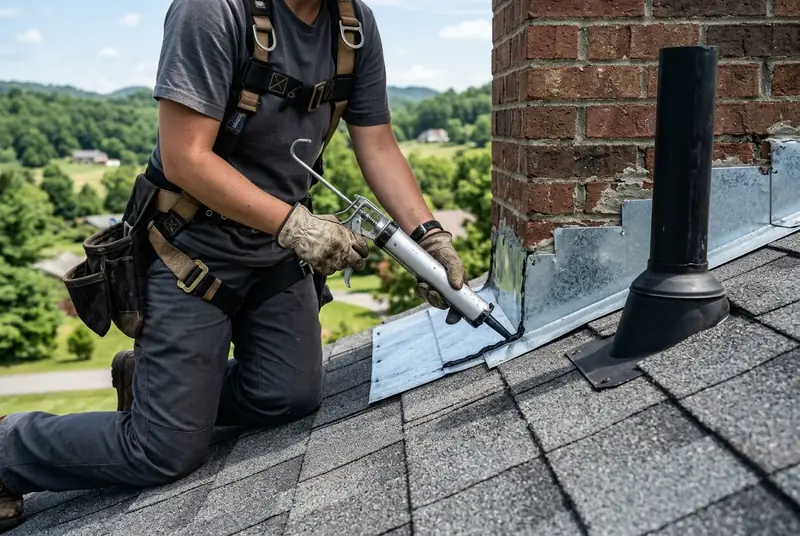
Leak & Flashing Repair
Chimney, sidewall, and valley flashing are the most common sources of a persistent leak that isn't obviously a missing-shingle problem. Metal flashing corrodes, sealant dries out, and step flashing can work loose over years of thermal movement.
- Chimney counter-flashing and step flashing resealed or replaced
- Sidewall and skylight flashing inspected for separation
- Typically a same-day repair
Pipe Boot & Penetration Repair
The rubber or neoprene collar around a plumbing vent stack hardens and cracks with age — usually somewhere between 10 and 15 years — creating a slow, easy-to-miss leak right at the penetration.
- Cracked or hardened boot collars replaced
- Surrounding shingles checked for water staining underneath
- One of the fastest, most affordable repairs on this list
Valley & Decking Spot Repair
Valleys carry more water than any other part of a roof, so wear and metal fatigue there tends to leak sooner than flatter areas. Where a leak has been active for a while, the decking underneath is checked for soft spots and replaced where needed.
- Valley metal or woven shingles repaired or replaced
- Localized decking sections replaced where soft or delaminated
- Surrounding shingles matched as closely as available materials allow
How a Leak Is Actually Diagnosed
A ceiling stain almost never sits directly below where water is actually entering the roof. Water travels along decking, framing, and insulation before it shows up inside.
Trace From the Attic, Not the Ceiling
Water stains and rafter discoloration in the attic are followed uphill toward the actual entry point — often several feet from where the interior stain appears.
Check Every Penetration First
Pipe boots, chimneys, skylights, and vent stacks fail far more often than open shingle field — they're checked before assuming a leak is a shingle problem.
Confirm Before Opening Anything Up
Where the source isn't obvious, a controlled water test on individual roof sections can isolate the entry point before any shingles come off.
Once the source is confirmed, you get a written scope naming exactly what's being fixed — not a generic "roof repair" line item. If more is found once the area is opened up (soft decking, a second unrelated failure point), that gets flagged and priced separately before any additional work happens, not added to the invoice afterward.
When Widespread Damage or Code Limits Require Replacement
Under the adopted International Residential Code (IRC Section R908.3) and International Building Code (IBC Section 1511.3), a partial repair or recover is not permitted over deteriorated decking or where two roof layers already exist. As a practical estimating and insurance benchmark, once damage spans roughly a quarter or more of a roof slope — or surrounding shingles are too brittle to unseal and re-nail — replacing the affected section or full roof is the durable, code-compliant path.
- Applies whether the driver is storm damage, age, or several separate repair calls adding up over a year
- Local enforcement details vary by jurisdiction and code edition — your town's page has the specific building department to confirm with
- A real reason a "just patch it" request sometimes gets a different answer than expected — not upselling, code compliance
The Roof Repair Process
Most single-source repairs are completed in a single visit once the source is confirmed.
Free Inspection & Diagnosis
A specialist traces the actual source of the problem — not just the visible symptom — before recommending a fix.
Written Scope & Estimate
You receive a specific, itemized description of what's being repaired and why — not a vague "roof repair" line item.
Repair Performed
Most flashing, pipe boot, and single-area repairs are completed the same day. If additional issues are found once the area is opened, you're told before any extra work happens.
Walkthrough & Warranty
The completed repair is reviewed with you, and workmanship warranty documentation from the performing contractor is provided.
What Roof Repair Costs in Sumner County
General 2026 market ranges by repair type — your actual price depends on what the inspection finds, not a flat rate.
Spot Repair
1–3 shingles, minor flashing, or a pipe bootStandard Leak or Flashing Repair
Chimney, skylight, or sidewall flashingValley or Decking Spot Repair
Includes localized decking replacement where neededEvery quote is a detailed written scope and estimate, delivered after a free on-site inspection. If your roof needs more extensive work, see Roof Replacement Cost Guide.
What Roof Repair Fixes — and What It Doesn't
A repair solves a defined, localized problem. It's not a substitute for a roof that's genuinely reaching the end of its service life.
What Roof Repair Fixes
- A single active leak with a confirmed source
- A handful of missing, cracked, or wind-lifted shingles
- Failed flashing, pipe boots, or localized decking
- A valley or single roof plane that's fallen behind the rest of the roof
What It Doesn't Fix
- Damage spread across most roof slopes — see Roof Replacement
- Hail or wind damage tied to a specific recent storm — see Storm Damage & Insurance Claims
- Failing or undersized gutters — see Gutters & Downspouts
- Widespread multi-slope damage or two-layer recover limits — that becomes a replacement conversation
Material Matching & Discontinued Shingles
Shingles fade with UV exposure, and older colors or profiles are sometimes discontinued by the manufacturer. A repair uses the closest available match, but on an older roof, a perfect blend isn't always possible — especially on a highly visible slope. This is worth discussing before the work starts, not after.
If This Is a Storm-Related Repair
If the damage traces back to a specific hail or wind event, it may be worth documenting before repair rather than after — that's a different, insurance-focused process. See Storm Damage & Insurance Claims for how that documentation works, including how contractor estimates and carrier scopes relate.
Emergency Repair & Temporary Mitigation
If water is actively coming in, the priority is stopping it — a permanent repair follows once it's safe to do the work properly.
What Happens First
- Priority dispatch ahead of routine, scheduled repair calls
- A temporary tarp or seal to stop active intrusion — this is mitigation, not the permanent fix
- Photographed before and after, useful documentation whether or not a claim is involved
Before Help Arrives
- Move furniture and valuables out from under an active leak if it's safe to do so
- Avoid a sagging or water-saturated ceiling — it can fail without warning
- Do not go on the roof yourself, especially in wet or windy conditions
Which Service Do You Actually Need?
A rough starting point — a free inspection confirms it either way.
Related Services
Roof Repair Across Sumner County
Roof repair is dispatched through our partner network across Sumner County.
Repair calls range from a single pipe boot on a newer subdivision roof to flashing work on a decades-old home near a downtown square. Local factors like housing stock age and HOA requirements vary by town — see your town's page below for specifics.
Roof Repair FAQs
It depends on how localized the damage is, your roof's age, and whether surrounding shingles pass brittle testing and code recover limits (see above). A free inspection gives you a straight answer — see our Repair vs. Replace Guide for the general decision factors.
Most spot repairs (a few shingles, a pipe boot, minor flashing) run $150–$500. Standard flashing repairs run $200–$600, and valley or decking spot repairs run $300–$1,500 depending on scope. See the pricing section above for details.
Most single-source repairs (flashing, pipe boots, a handful of shingles) are completed in a single visit once the source is confirmed. More extensive valley or decking work can take longer.
Under the IRC (Section R908.3) and IBC (Section 1511.3), if more than about 25% of a roof section is repaired or recovered within a 12-month period, that section generally has to be brought up to current code rather than simply patched. It's a real code threshold, not a sales pitch — your inspection will flag it if it's relevant to your project.
You're told before any additional work happens or is added to the invoice. Soft decking under a valley, or a second unrelated failure point, is common enough that it's worth asking about upfront — it doesn't mean the original scope was wrong.
As closely as available materials allow. UV-faded shingles and discontinued color lines can make a perfect match difficult on an older roof, especially on a highly visible slope — worth discussing before the work starts.
Yes — if water is actively coming in, call us directly rather than waiting for a scheduled inspection. Emergency mitigation gets priority dispatch, with a permanent repair to follow.
If you can point to a specific storm, it's worth having the damage documented before repair — see Storm Damage & Insurance Claims. If it's general wear with no specific event behind it, a standard repair is the more direct path.
Minor spot repairs often don't require a permit, but that depends on scope and your specific municipality — and structural decking or full-slope replacement scopes require municipal permits. Your town's page lists the local building and codes department to confirm with directly.
The performing contractor provides a workmanship warranty on the repair itself; specific terms vary by contractor and repair type. Always review the specific warranty documentation you're given.
Get the Actual Source of the Problem Fixed
A leak or missing shingle doesn't get better with time. Every inspection is free, and you get a specific written scope before any work happens.
TN Roofing Crew connects property owners with vetted, independently licensed and insured Tennessee roofing contractors. Inspections, repairs, and workmanship warranties are provided directly by the independent licensed contractor assigned to your home.
Request a Free Inspection
A local specialist diagnoses the actual source and gives you a written scope — no obligation.
Common Roof Repair Scope & Pricing Benchmarks in Sumner County
Not sure what is causing your leak? Use our Roof Problem Diagnostic Guide to triage your symptoms before dispatch.
Every roof leak or damaged component requires targeted technical diagnosis before replacement is considered. The table below outlines standard component repair protocols, typical root causes, and regional price benchmarks across Middle Tennessee.
| Repair Scope | Failure Mechanism / Root Cause | Typical Turnkey Benchmark | Associated System Risk |
|---|---|---|---|
| Pipe Boot Collar Replacement | UV degradation and ozone ozone-cracking of neoprene rubber seal ring | $225 – $450 per boot | Attic sheathing rot, ceiling drywall water staining below vent stacks |
| Chimney & Step Flashing Resealing / Reline | Mortar expansion, failed counter-flashing mastic, or corroded L-flashing | $450 – $1,250 | Framing rot along chimney chase, hidden insulation mold, interior wall damage |
| Valley Flashing Replacement | Accumulated pine needles/leaves holding moisture; worn valley metal or ice barrier | $650 – $1,600 per run | Structural valley rafter deterioration, high-volume interior water entry |
| Wind-Blown Shingle Tab Replacement | High-wind gusts exceeding 60 mph unsealing aged adhesive sealant strips | $300 – $650 (1–2 bundles) | Exposed underlayment weathering, rapid leak migration during thunderstorms |
| Ridge Vent Resealing / Replacement | Backed-out roofing nails, warped plastic baffles, or wind-blown ridge caps | $400 – $950 | Blown-in rain during severe convection storms, reduced attic ventilation |
Repair vs. Replacement Decision Thresholds
Determining whether a roof requires targeted repair or full system replacement is governed by physical age, damage concentration, and local building code thresholds.
| Technical Indicator | Recommend Targeted Repair | Recommend Full Replacement |
|---|---|---|
| Shingle Age & Flexibility | Under 15 years old; shingles pass brittle test without snapping | Exceeds 18–20 years; shingles snap when lifted for nail placement |
| Surface Area Damage | Isolated damage affecting less than 20% of an individual roof slope | Widespread damage exceeding 25% of roof area or multiple slopes |
| Decking Condition | Solid decking with isolated sheathing moisture dried without structural rot | Soft spots, extensive wood rot, or widespread plywood delamination |
| Leak History | Single, newly developed leak at identifiable penetration | Multiple recurring leaks occurring across disparate valleys and fields |
| Storm Damage Scope | Isolated wind-lifted shingles below insurance claim deductible | Confirmed hail bruising or widespread wind damage meeting claim criteria |
Guides, Pricing & Local Roofing Articles
- Chimney Flashing Failure: The #1 Hidden Cause of Roof Leaks →
- Ice Dams in Tennessee: Causes & Eave Leak Prevention →
- Can You Repair a Roof in the Rain? Emergency Tarping Explained →
- How Many Roof Repairs Are Too Many Before Replacing? →
- Skylight Leaks: Repair the Flashing or Replace the Unit? →
- Animal Damage to Roof Vents: Repair Costs & Metal Screens →