Third repair this year? Brittle shingles and multi-slope leaks mean it may be time to replace. Learn the thresholds, then get a quote: (615) 647-8320.
As a general engineering rule, if your asphalt shingle roof has required more than two or three separate leak repairs within a 24-month period, if cumulative repair expenditures exceed 25% to 30% of a full replacement cost, or if your roof exceeds 18 to 20 years of age in Middle Tennessee, continuing to patch the roof is financially counterproductive. When an asphalt roof reaches systemic material degradation, repairing one isolated leak simply shifts thermal water stress to the next weakest point, leading to recurring interior water damage and wasted repair capital.
The 4 Tipping Points: When to Transition from Repair to Replacement
Homeowners in Hendersonville, Gallatin, White House, and Goodlettsville frequently grapple with whether to patch an existing roof or commit to a full tear-off and replacement. Evaluate these four definitive engineering benchmarks:
- 01
The Cumulative Repair Cost Benchmark (25% of Replacement Cost)
If a proposed repair estimate exceeds 25% of the total cost of a brand-new roof — or if you have already spent $2,000 to $3,500 over the past two years on multiple patch attempts — continuing to repair is throwing good money after bad. A new roof resets your warranty to zero, improves energy efficiency, and eliminates recurring interior drywall damage.
- 02
Roof Age & Middle Tennessee Thermal Baking
Asphalt shingles in Tennessee endure brutal summer heat (reaching 140°F+ in attics) and seasonal humidity from Old Hickory Lake. Standard 3-tab shingles reach physical embrittlement at 12 to 15 years, while architectural shingles begin losing functional granule adhesion between 18 and 22 years. If your roof is past 18 years old, individual shingles are too brittle to lift without cracking surrounding tabs during repairs.
- 03
Systemic Widespread vs. Localized Isolated Leaks
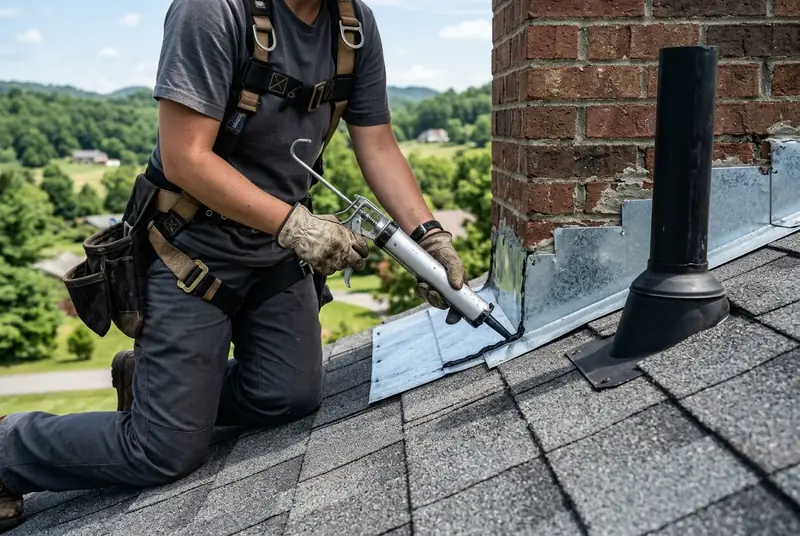
An isolated leak caused by a failing rubber pipe boot or a small patch of wind-blown shingles on a 7-year-old roof warrants a simple $350 to $650 repair. However, when leaks appear simultaneously in valleys, around chimneys, and across field shingles, the waterproofing assembly has failed systemically.
- 04
Shingle Brittleness & The "Bend Test" Failure
To perform a proper shingle repair, a technician must carefully pry up the overlapping course to access nails beneath. On an aged roof, bending an adjacent shingle by just 45 degrees causes the fiberglass mat to snap. If a roofer cannot replace one shingle without damaging three adjacent shingles, the roof is unrepairable.
Decision Matrix: Repair vs. Full Roof Replacement
The table below provides clear diagnostic guidance across common roofing scenarios:
| Roof Diagnostic Condition | Roof Age | Recommended Action | Financial & Structural Rationale |
|---|---|---|---|
| Single cracked pipe boot or collar | Under 12 Years | Isolated Repair ($250 – $450) | Field shingles remain flexible; surrounding deck is sound |
| Small patch of wind-blown shingles (<1 sq) | Under 15 Years | Spot Shingle Repair ($350 – $600) | Matching shingles available; thermal sealant bonds well |
| Multiple leaks on opposing slopes | 15 – 20+ Years | Full Replacement ($9,500 – $16,500) | Underlayment has degraded; repairs will fail elsewhere |
| Widespread hail bruising across slopes | Any Age | Insurance Storm Claim | Covered peril; carrier funds replacement minus deductible |
| Discontinued shingle profile / color | 12+ Years | Full Slope / Total Replacement | Mismatched shingles violate IRC uniformity & water-shedding |
| Soft, spongy decking along eaves/valleys | 15+ Years | Full Tear-Off & Re-decking | Structural hazard; requires full sheathing replacement |
The Discontinued Shingle Dilemma in Tennessee
Homeowners frequently encounter situations where their roof is only 12 to 14 years old, but the existing shingle profile (such as older dimensional lines or metric 3-tabs) has been discontinued by manufacturers:
When replacement shingles of matching dimensions cannot be sourced, inserting mismatched shingles creates irregular courses, exposes unsealed nail lines, and compromises the roof's water-shedding integrity. During insurance claim evaluations, experienced contractors document shingle obsolescence with manufacturer verification, demonstrating that a partial patch is technically non-compliant and requiring full replacement.
Municipal Permitting & Code Compliance in Sumner County
Minor spot repairs — such as replacing a pipe boot or a half-bundle of shingles — generally do not require a municipal building permit in Sumner County. However, once a repair scope involves structural decking replacement or a full-slope reroof, local building departments (City of Hendersonville, Gallatin, White House, Goodlettsville, or Portland) mandate a formal building permit.
Pulling required permits guarantees that all adopted building codes — including mandatory IRC Section R905 perimeter drip edge and valley ice barrier membranes — are independently inspected by certified municipal building officials.
IRC Deck Integrity & Shingle Brittleness Thresholds
Middle Tennessee's extreme climate dynamics—ranging from sub-freezing winter ice storms to 95°F midsummer afternoons with intense ultraviolet radiation—accelerate the natural aging of asphalt shingle binders. Sumner County property owners should evaluate the following structural thresholds when deciding between ongoing patch repairs and complete replacement:
- The 45-Degree Brittle Bend Test: When an experienced technician carefully lifts an adjacent shingle tab 45 degrees to access fasteners during a repair, a pliable shingle flexes smoothly without cracking. If the top surface fractures, sheds dense granule layers, or tears at the nail line, the entire roof slope has reached thermal embrittlement and cannot support further localized nail-driving.
- Cumulative 30% Financial Rule: If cumulative localized repair costs over a 24- to 36-month window approach 30% to 35% of full tear-off and replacement valuation, continuing to repair individual leaks is economically counterproductive.
- Substrate Decking Deterioration: Under International Residential Code (IRC) section R905, shingles must be nailed into solid, smooth sheathing (typically 7/16-inch OSB or 1/2-inch CDX plywood). Repeated chronic leaks soften wood fibers, causing nail pull-out and spongy decking that fails municipal inspection standards.
- Discontinued Shingle Profiles: If your home features discontinued 3-tab dimensions or obsolete metric shingle sizes, replacement shingles will not align with existing courses, creating unsealed step joints vulnerable to wind-driven rain.
Frequently Asked Questions About Roof Repair Limits
While technically possible, partial slope replacements are rarely advisable on residential homes. Tying new shingles into aged shingles along the ridge creates an obvious visual mismatch, voids transferable manufacturer system warranties, and leaves the remaining older slope vulnerable to failure within a few years, doubling future mobilization costs.
Yes. A roof covered in visible tar patches, mismatched shingle batches, and piecemeal repairs is an immediate red flag to home inspectors and prospective buyers. Buyers routinely demand significant price concessions ($10,000 to $15,000) or require complete replacement as a condition of purchase.
Storm damage exhibits clear physical signatures: circular hail impact bruises that fracture the fiberglass mat, or wind-creased tabs along eaves and rakes. Aging roofs display uniform granule loss across entire slopes, curled tab edges, and hairline thermal crazing cracks without impact depressions.
Next Steps & Related Roofing Guides
Related Sumner County Roofing Guides: Continue reading Ice Dams in Tennessee Roofs: Causes and How to Prevent Them and Can You Repair a Roof in the Rain? What Crews Really Do.