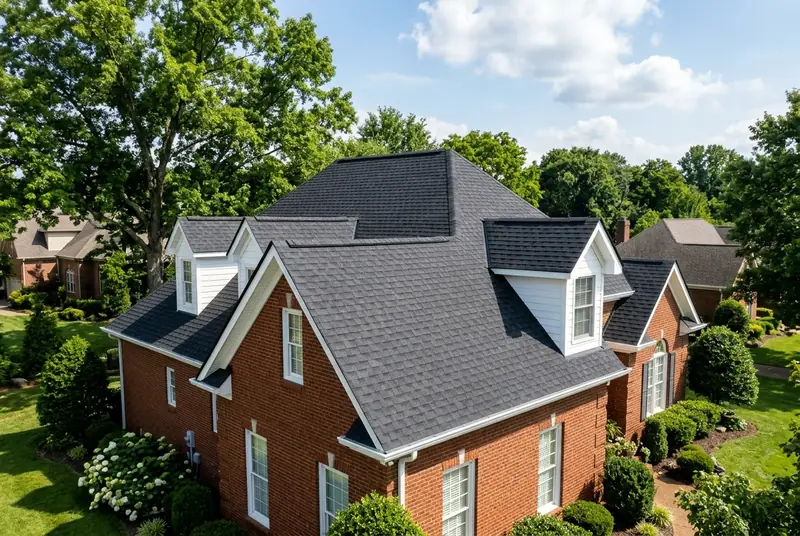
A roofing square is 100 sq ft, and quotes mix both units. Learn to convert them so bids compare fairly, then send yours for a look: (615) 647-8320.
In residential and commercial roofing, a "square" is the universal unit of measurement equal to exactly 100 square feet of roof surface area, whereas square footage often refers to a home's heated interior floor plan. A 2,400-square-foot house does not have a 2,400-square-foot roof; pitch steepness, eaves overhangs, and valley waste factors typically increase actual roof surface area by 15% to 30%, resulting in 28 to 32 roofing squares. Understanding this distinction prevents significant budget miscalculations when comparing contractor estimates.
Why Does the Roofing Industry Measure in Squares Instead of Square Feet?
Throughout the United States and specifically across Middle Tennessee roofing supply channels, building materials are manufactured, packaged, and priced by the "square." For example, three bundles of standard architectural shingles cover exactly one square (100 square feet). Underlayment rolls are packaged in 4-square or 10-square increments, and nail counts are calculated per square.
When homeowners attempt to estimate roofing costs by simply multiplying their home's interior heated square footage by a generic per-square-foot price, they consistently underestimate the materials and labor required. A home's footprint is a flat, two-dimensional plane, but a roof is a three-dimensional sloped structure with overhangs, rakes, hips, and dormers that expand the total surface area significantly.
The Mathematical Formula: Converting Floor Plan to Roof Surface Squares
Professional roofing estimators utilize a standardized geometric formula to convert a building's ground-level footprint into actual roof surface area:
$$\text{Roof Surface Area} = \text{Ground Footprint} \times \text{Pitch Multiplier} \times \text{Waste Factor}$$
Here is how each variable impacts the final square count for a Sumner County residence:
- Ground Footprint: Includes the heated living area plus unheated spaces covered by the roof structure, such as attached two-car garages, covered front porches, and rear patio extensions. A 2,000 sq ft home with a 450 sq ft garage has a 2,450 sq ft ground footprint.
- Pitch Multiplier: Roof slope is expressed as rise over run (inches of vertical rise per 12 inches of horizontal run). A low-slope 4:12 roof has a pitch multiplier of 1.054, while a steep 8:12 roof has a multiplier of 1.202, and a dramatic 12:12 roof has a multiplier of 1.414.
- Waste Factor: Cutting shingles to fit angular hips, valleys, gables, and chimney sidewalls creates scrap material that cannot be reused. Simple gable roofs carry a 10% waste factor, while complex multi-gabled roofs with multiple valleys require 15% to 20% waste allowance.
Pitch Multiplier Comparison Across Common Sumner County Home Styles
The table below illustrates how different roof pitches dramatically alter actual roof squares on a home with an identical 2,000-square-foot ground footprint (assuming a standard 12% cut waste factor):
| Roof Pitch (Slope) | Geometric Multiplier | Actual Roof Surface Area | Total Squares (Incl. 12% Waste) | Estimated Shingle Bundles |
|---|---|---|---|---|
| 4:12 Pitch (Low Slope) Typical Mid-Century Ranch | 1.054 | 2,108 sq ft | 23.6 Squares (24 Sq) | 72 Bundles |
| 6:12 Pitch (Moderate Slope) Standard Suburban Subdivision | 1.118 | 2,236 sq ft | 25.0 Squares (25 Sq) | 75 Bundles |
| 8:12 Pitch (Moderate-Steep) Traditional Two-Story Colonial | 1.202 | 2,404 sq ft | 26.9 Squares (27 Sq) | 81 Bundles |
| 10:12 Pitch (Steep Slope) Modern Craftsman / Cape Cod | 1.302 | 2,604 sq ft | 29.2 Squares (30 Sq) | 90 Bundles |
| 12:12 Pitch (Extreme Slope) Waterfront Luxury Estate | 1.414 | 2,828 sq ft | 31.7 Squares (32 Sq) | 96 Bundles |
Unit Price Comparison: Cost Per Square vs. Cost Per Square Foot
To translate between these two metrics, simply divide the cost per square by 100. For example, if a contractor quotes $450 per square installed for architectural shingles, the direct material and labor cost is $4.50 per square foot of actual roof surface:
- Standard Architectural Shingles: $380 to $550 per square ($3.80 to $5.50 per square foot of roof surface).
- Class 4 Impact-Resistant Shingles: $480 to $680 per square ($4.80 to $6.80 per square foot of roof surface).
- Standing Seam Metal: $900 to $1,450 per square ($9.00 to $14.50 per square foot of roof surface).
Notice that if someone incorrectly calculated a 2,000 sq ft home at $4.50 per square foot of living area, they would estimate $9,000. But if that home has an 8:12 pitch and attached garage totaling 27 squares, the real retail replacement cost is $12,150 — a $3,150 discrepancy resulting solely from confusing floor area with roof squares.
How Do Valleys and Hip Ridges Influence Square Calculations?
Valleys and hip ridges require diagonal shingle cuts that create triangular scraps. In closed-cut or open-metal valleys, every shingle entering the valley must be trimmed, and the cut-off end cannot be utilized on the opposite rake.
Furthermore, hip roofs require specialized cap shingles along all four diagonal ridges. Estimators order hip and ridge cap shingles in linear feet rather than square footage, which adds to the overall materials package. When reviewing estimates from contractors in Hendersonville or Gallatin, verify whether the quoted square count represents net surface area or gross ordering squares including waste.
Architectural Complexity & Real-World Waste Factors
Roof geometric complexity dramatically influences the total number of squares required to complete an installation. A standard rectangular ranch home with a simple two-plane gable roof incurs minimal cut scrap, operating comfortably at an 8% to 10% waste factor. In contrast, complex architectural profiles — such as modern Craftsman homes, multi-gabled Victorians, or homes with multiple intersecting valleys, dormers, and hip lines common in Hendersonville and Gallatin master-planned communities — require 15% to 20% waste allowance.
When shingles are installed across valleys and hips, each diagonal cut creates unusable triangular remnants. Shingle manufacturers package dimensional shingles in three bundles per square, and partial bundles cannot be split during ordering. Licensed contractors account for both geometric cut waste and manufacturer bundle packaging increments to ensure crews have adequate matching shingles on-site without unnecessary excess material charges.
Frequently Asked Questions About Roof Squares
Exactly 100 square feet. A roof with 2,500 square feet of surface area equals 25 roofing squares. Shingles are typically packaged three bundles per square, meaning 75 bundles cover 25 squares.
Discrepancies usually occur due to differing waste factor assumptions (e.g., one contractor estimated 10% waste while another estimated 15%), inclusion versus exclusion of attached patio overhangs, or differences between aerial satellite measurement software and manual tape measurements.
Yes. Roofs with a pitch of 8:12 or steeper are classified as "steep slope" and carry labor surcharges (typically $20 to $50 extra per square) because installers must utilize safety harnesses, staging planks, and specialized toe boards to navigate the roof safely.
Next Steps & Related Roofing Guides
Related Sumner County Roofing Guides: Continue reading Uninsured Roof Replacement Cost in Tennessee: 2026 Prices and Does a New Roof Increase Home Value in Sumner County, TN?.