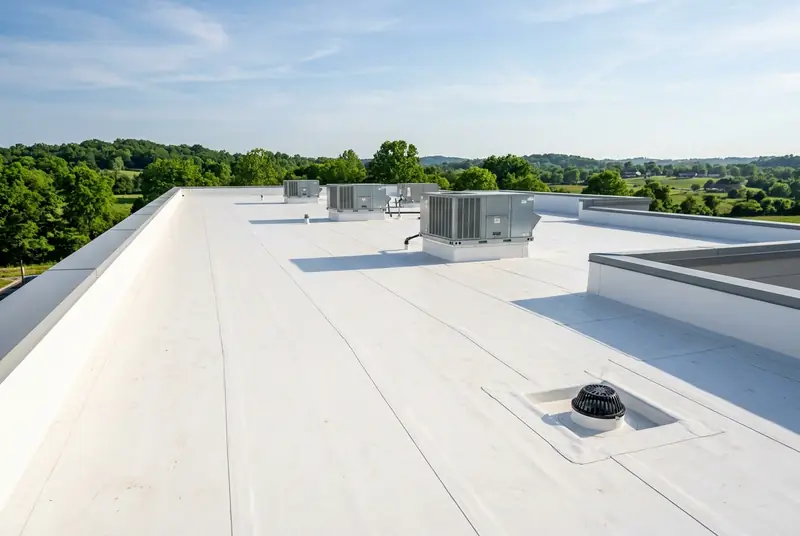
Inspect commercial flat roofs twice a year and after storms. Learn what to check, from ponding to seams, then schedule yours: (615) 647-8320.
Commercial flat and low-slope roofing systems represent substantial capital investments that protect millions of dollars in tenant inventory, production machinery, and commercial structural assets across Sumner County. Unlike steep-slope residential shingle roofs that shed precipitation immediately by gravity, commercial flat roofs rely on engineered slopes, internal drainage basins, and watertight sealed seams. Establishing an intentional professional inspection schedule is the single most effective way to prevent catastrophic interior water damage and protect manufacturer warranty coverage.
The Standard Commercial Inspection Cadence: Bi-Annual + Event-Driven
Industry standards established by the National Roofing Contractors Association (NRCA) and commercial roofing manufacturers mandate a core inspection schedule consisting of two scheduled audits per year plus event-triggered assessments:
- Spring Post-Winter Audit (March – April): Evaluates roof conditions following winter freeze-thaw cycles. Technicians inspect for membrane contraction splits, freeze damage around internal drains, separation along metal edge flashings, and damage caused by winter HVAC maintenance contractors.
- Late Autumn Pre-Winter Audit (October – November): Conducted after regional hardwood trees shed leaves. Technicians thoroughly clean internal drain sumps, remove debris from scupper boxes, inspect parapet expansion joints, and ensure seams are fully sealed before freezing weather and winter storms arrive.
- Post-Severe Weather Event Inspections: Middle Tennessee experiences violent supercell thunderstorms producing hail and straight-line wind gusts exceeding 60 mph. Whenever severe weather strikes Sumner County, commercial roofs should be inspected immediately to identify punctures, fastener back-outs, or displaced metal flashing before minor leaks reach tenant spaces.
The 12-Point Commercial Flat Roof Inspection Checklist
A rigorous commercial roof evaluation goes far beyond a cursory visual walk-through. Certified commercial roofing inspectors systematically verify the following critical components:
| Inspection Target | Common Vulnerabilities Detected | Corrective Action Required |
|---|---|---|
| Internal Roof Drains & Sumps | Debris clogs, cracked cast-iron domes, failed clamping rings | Clear gravel/organic debris, replace broken strainer baskets, re-torque drain bolts |
| Through-Wall Scuppers & Downspouts | Leaf dams, solder fatigue, split flange membrane seals | Clear downspout conductor heads, reseal metal flange corners with flashing membrane |
| Membrane Field & Seam Laps | Fishmouth openings, dry unbonded welds, thermal stress cracking | Probe all seam laps, hot-air weld TPO patches, prime and tape EPDM joints |
| Parapet Walls & Coping Caps | Popped nails, dislodged cleat clips, degraded standing seam joints | Re-fasten loose coping metal with gasketed screws, reseal vertical coping joints |
| HVAC & Equipment Curbs | Deteriorated termination bars, unsealed pitch pockets, loose duct hoods | Replace dried pitch pocket filler, reseal polyurethane counterflashing beads |
| Expansion Joints | Bellows tears, metal cover displacement, loose expansion anchors | Install new elastomeric expansion bellows, anchor structural slide joints |
Advanced Diagnostic Technology: Infrared Drone Scans & Moisture Detection
Visual inspections alone cannot detect subsurface moisture trapped inside rigid polyisocyanurate insulation boards beneath the single-ply membrane. Modern diagnostic methods provide definitive proof of roof assembly health:
- High-Resolution Infrared Drone Thermography: Conducted just after sunset on a clear day, aerial thermal imaging measures the rate at which the roof sheds heat. Wet insulation has a higher thermal mass than dry insulation, retaining heat longer and glowing brightly on infrared camera displays. This pinpoints exact zones of subsurface water saturation without destructive testing.
- Electronic Leak Detection (High and Low Voltage Vector Mapping): Vector mapping passes an electric current across the wet membrane surface. Because the membrane acts as an insulator and water grounds to the structural steel or concrete deck, current flow directly reveals pinhole breaches invisible to the naked eye.
- Core Sampling and Moisture Probes: When thermal anomalies appear, technicians perform calibrated non-destructive impedance testing or minimal 2-inch core extractions to verify insulation wetness and determine whether localized drying or full board replacement is required.
Preserving Manufacturer NDL (No Dollar Limit) Warranty Protections
Major commercial membrane manufacturers—including Carlisle SynTec, GAF Commercial, Firestone/Elevate, and Johns Manville—issue 15- to 30-year No Dollar Limit (NDL) system warranties on certified commercial installations. However, property owners often fail to realize that these warranties contain strict maintenance requirements:
- Mandatory Maintenance Records: Warranty fine print explicitly requires the building owner to perform regular documented inspections and keep drainage systems free of debris. Failure to clear blocked drains resulting in ponding water voids warranty claims for subsequent seam failures.
- Uncertified Penetrations: If a third-party HVAC contractor, solar installer, or satellite technician installs equipment on the roof without an authorized manufacturer-certified roofing contractor sealing the curb or pitch pocket, the entire manufacturer warranty can be voided.
- Timely Notice Requirements: Most commercial warranties require written notification of roof leaks within 30 days of initial discovery. Prompt inspection and immediate professional repair reporting protect your capital investment.
Frequently Asked Questions About Commercial Flat Roof Inspections
Does commercial building insurance require regular roof inspections?
Yes. Commercial property insurance policies routinely include clauses requiring reasonable maintenance of the building envelope. If an insurer determines that an interior water damage claim resulted from long-term neglect, clogged drains, or unaddressed roof deterioration rather than a sudden storm event, they may deny coverage for damaged tenant property and building finishes.
How does an infrared drone scan detect hidden commercial roof leaks?
Infrared drone thermography detects differences in thermal capacitance. After the sun sets, dry roof insulation cools rapidly, while moisture-saturated insulation retains absorbed solar heat much longer. The thermal camera captures this temperature differential as high-contrast heat blooms, pinpointing exact pockets of trapped water.
What is an NDL warranty and how does inspection affect it?
An NDL (No Dollar Limit) warranty is a premium commercial manufacturer warranty that covers the full labor and material cost of correcting leaks caused by manufacturing defects or installation errors, regardless of total cost. However, manufacturers condition NDL warranties on the owner performing documented bi-annual maintenance and keeping all drainage paths unobstructed.
What are the earliest visual signs of commercial membrane failure?
Early warning signs include standing water persisting longer than 48 hours after rainfall, surface crazing or micro-cracks in the membrane, bubbling or blistering caused by trapped moisture vapor, loose or unbonded seam laps (fishmouths), and gaps in perimeter parapet coping joints.
Protect your commercial facility with structured maintenance programs. Learn about our specialized Commercial Roofing Services, explore local capabilities in our Hendersonville Commercial Flat Roofing guide, or explore regional options in Gallatin Commercial Roofing.
Schedule certified commercial roof inspections and review municipal building guidelines:
Related Sumner County Roofing Guides: Continue reading TPO vs. EPDM Commercial Roofing in Sumner County, TN and Commercial Roof Leak Liability: A Property Manager Guide.