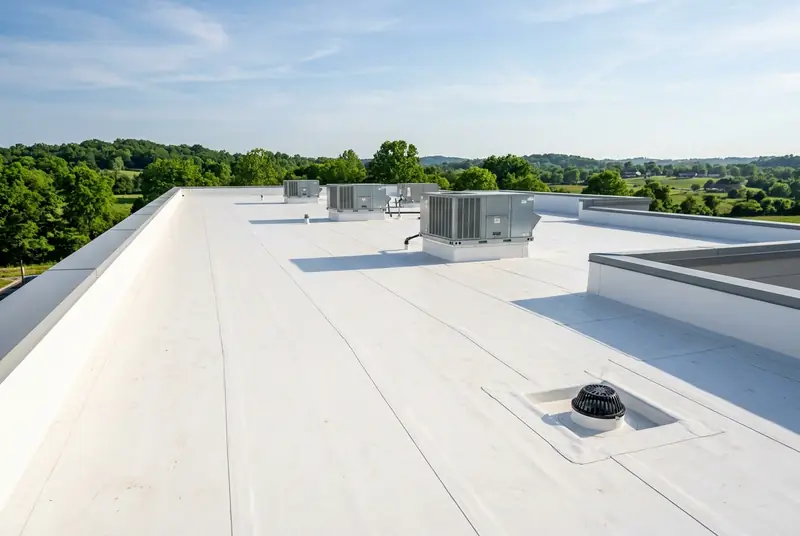
Water standing 48 hours after rain can damage a flat roof. Learn when ponding is normal and when to act, then book a flat roof check: (615) 647-8320.
Standing water on a commercial flat roof after a heavy Middle Tennessee rainstorm is one of the most common visual concerns for building owners and property managers across Sumner County. Because flat roofs are not entirely level but rather engineered with slight positive slopes, small residual puddles frequently form after precipitation. However, distinguishing between normal post-storm temporary accumulation and hazardous, chronic ponding water is critical for structural safety, membrane longevity, and manufacturer warranty protection.
The Industry Standard: The 48-Hour Evaporation Rule
The National Roofing Contractors Association (NRCA), the Single Ply Roofing Industry (SPRI), and the International Building Code (IBC) define ponding water according to an objective time threshold:
- Normal Temporary Accumulation (Under 48 Hours): Water that accumulates during a storm but completely evaporates or drains away within 24 to 48 hours under normal ambient conditions is considered standard performance. All commercial low-slope roof membranes are formulated to withstand temporary wet exposure.
- Chronic Ponding Water (Over 48 Hours): Any standing water that remains on a roof surface 48 hours or longer after rainfall ends—in weather conditions that are suitable for drying—is classified as chronic ponding water. Chronic ponding represents a functional defect in roof slope, drainage capacity, or structural support.
- Winter Freeze Ponding: During cold Middle Tennessee winter months with low sun angles and high humidity, evaporation rates slow down. If standing water repeatedly freezes into solid ice lenses, mechanical expansion stress on membrane seams increases substantially.
The Physical and Chemical Hazards of Chronic Ponding Water
Allowing chronic ponding water to persist on commercial flat roofs triggers severe mechanical, chemical, and structural risks:
| Hazard Category | Physical Mechanism of Action | Long-Term Commercial Risk |
|---|---|---|
| Structural Dead Load Overload | Standing water weighs 5.2 lbs per square foot per inch of depth; 3 inches of water adds 15.6 lbs/sq ft | Excessive deflection of structural bar joists or wood rafters, risking deck sagging or structural collapse |
| Accelerated UV & Thermal Degradation | Water puddles act as optical lenses, concentrating solar ultraviolet rays directly onto the membrane | Premature embrittlement of membrane polymers and breakdown of EPDM seam adhesives |
| Biological Biofilm & Algae Growth | Stagnant water traps organic silt, fostering cyanobacteria, algae, and vegetation growth | Plant roots penetrate microscopic membrane pores; decomposing matter generates acidic compounds |
| Subsurface Insulation Saturation | Microscopic punctures or pinholes under hydrostatic pressure force water continuously into substrate | Destroys R-30 insulation thermal resistance, saturates wood decking, and corrodes steel fasteners |
| Manufacturer Warranty Disclaimers | Commercial warranties explicitly exclude damage resulting from ponding water or clogged drains | Building owner forfeits warranty coverage for seam failure or membrane cracking in ponded zones |
Common Causes of Commercial Roof Ponding in Middle Tennessee
Chronic ponding water is rarely caused by the roofing membrane itself; rather, it results from drainage design, structural movement, or maintenance neglect:
- Inadequate Slope-to-Drain Design: The International Building Code requires all new commercial roofs to achieve a minimum finished slope of 1/4 inch per foot (2%) toward drainage outlets. Older Sumner County buildings constructed with 1/8-inch slope or flat structural decks frequently suffer from inadequate drainage gradient.
- Structural Deflection and Creep: Over decades, heavy rooftop HVAC units placed between structural joists cause structural decking to deflect downward, creating permanent low spots where water naturally collects.
- Drain and Scupper Obstructions: Accumulations of autumn leaves, tree branches, dirt, and HVAC contractor debris around drain strainers or through-wall scuppers create artificial dams that hold water across hundreds of square feet of roof area.
- Improper Drain Elevation: In re-roofing projects where new insulation is installed without sumping the drains, the drain rings may sit slightly higher than the surrounding roof plane, preventing the last 1 to 2 inches of water from draining.
Engineering Solutions to Eliminate Commercial Ponding Water
Correcting chronic ponding water requires targeted architectural and mechanical remediation tailored to the underlying cause:
- Tapered Polyisocyanurate Insulation Systems: During roof replacement or recover projects, installing factory-tapered rigid polyisocyanurate insulation panels creates engineered slopes (typically 1/8-inch or 1/4-inch per foot) that direct water away from low spots and toward primary drains.
- Engineered Crickets and Saddles: Installing triangular diamond-shaped tapered crickets between drains or behind rooftop HVAC curbs splits water flow and prevents water from pooling in dead valleys between drainage basins.
- Drain Sump Pans: Sinking internal roof drains into 4x4-foot or 8x8-foot tapered sump pans lowers the drain clamping ring 1 to 2 inches below the adjacent roof surface, ensuring complete drainage evacuation.
- Supplemental Drains or Siphon Drainage: In severe low spots where structural deflection cannot be corrected with insulation, commercial contractors can install supplemental primary internal drains connected to the municipal storm sewer or exterior overflow scuppers.
Frequently Asked Questions About Flat Roof Ponding Water
Is standing water after a rainstorm normal on a commercial flat roof?
Yes, temporary standing water immediately following heavy precipitation is normal on low-slope roofs. However, if water remains in place longer than 48 hours in mild weather, it is classified as chronic ponding water that requires professional evaluation and drainage correction.
Does ponding water void commercial TPO or EPDM manufacturer warranties?
Most commercial manufacturer warranties contain explicit exclusions for damage caused by ponding water or failure to maintain clean drainage systems. While modern membranes resist water, prolonged hydrostatic pressure and thermal magnification can void warranty coverage for leaks occurring within chronic ponding zones.
How do you fix low spots on an existing flat roof without total tear-off?
If the existing roof insulation is dry and structurally sound, low spots can often be corrected by installing localized tapered polyiso saddles, applying specialized roof leveling compounds, or adding auxiliary drain lines or siphon scuppers without requiring a full roof replacement.
What structural hazards does ponding water create during winter freeze-thaw cycles?
When standing water freezes into solid ice, water expands by approximately 9% in volume. This expansion exerts lateral hydrostatic pressure on membrane seams, tears flashings away from parapet walls, and creates dangerous ice loads that can compromise structural roof framing.
Eliminate drainage hazards and safeguard your building envelope. Explore our full suite of Commercial Roofing Solutions, reexplore local capabilities in our Gallatin Commercial Roofing guide, or connect with a local contractor for Hendersonville Commercial Flat Roofing inspections.
Connect with commercial roofing drainage engineers and schedule a roof slope audit:
Related Sumner County Roofing Guides: Continue reading TPO vs. EPDM Commercial Roofing in Sumner County, TN and How Often to Inspect a Commercial Flat Roof in Tennessee.