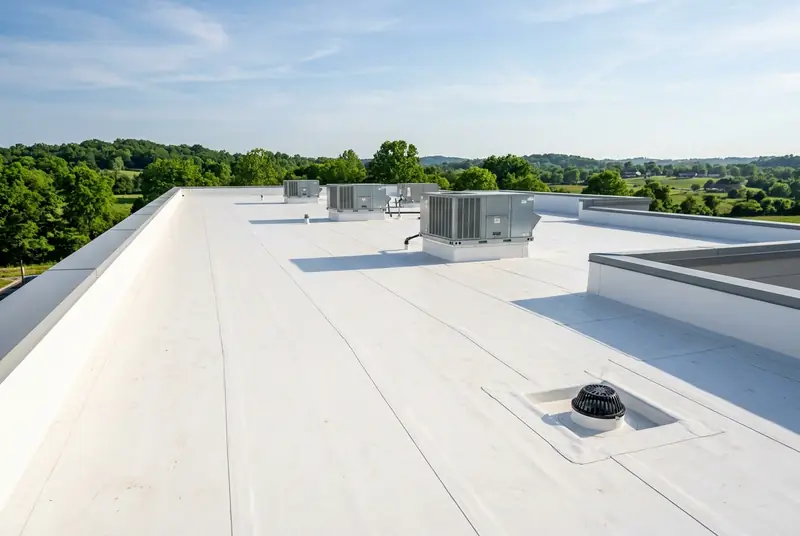
TPO or EPDM for your flat roof? Compare reflectivity, seams and cost for Sumner County, TN buildings, then request a bid from roofing pros: (615) 647-8320.
For commercial property owners, distribution centers, and retail facility managers across Sumner County, selecting the right single-ply low-slope roofing membrane represents one of the most significant capital asset decisions for a building. White Thermoplastic Polyolefin (TPO) and black Ethylene Propylene Diene Monomer (EPDM) synthetic rubber dominate the commercial market across Middle Tennessee, yet their chemical compositions, thermal performance, seam integrity, and lifetime maintenance requirements differ substantially.
Membrane Chemistry and Structural Attachment Differences
Both single-ply membranes deliver proven water protection when engineered correctly, but their underlying molecular chemistry dictates how they respond to Middle Tennessee's intense summer thermal cycling and winter freeze-thaw events:
- TPO (Thermoplastic Polyolefin): TPO is a polymer blend of polypropylene and ethylene-propylene rubber reinforced with an internal polyester scrim. Adjoining membrane sheets are fused using automated 1,000°F robotic hot-air welders, melting the top and bottom sheets together to create a monolithic plastic weld that is three to four times stronger than taped chemical adhesives.
- EPDM (Ethylene Propylene Diene Monomer): EPDM is a vulcanized thermoset synthetic rubber membrane. Because vulcanized rubber cannot be melted together once cured, seams must be chemically bonded using liquid solvent primers and double-sided butyl adhesive tape. Over 12 to 18 years, prolonged heat exposure and standing moisture can gradually degrade the adhesive bond along lap edges.
- Attachment Methods: Both membranes can be mechanically attached using heavy-gauge fasteners and stress plates driven into steel or wood decking, or fully adhered using solvent-based or water-based bonding adhesives over rigid polyisocyanurate (polyiso) insulation boards.
Thermal Energy Efficiency & Rooftop HVAC Performance
Middle Tennessee experiences sustained summer heatwaves where July ambient temperatures reach 90°F to 98°F with high humidity. The solar reflectance of your roof membrane directly impacts facility cooling expenses and rooftop equipment durability:
- Solar Reflectance Index (SRI): Bright white TPO features an initial Solar Reflectance Index of 0.78 to 0.86, reflecting up to 86% of solar radiation away from the building. Under direct summer sun, a white TPO roof remains within 10°F to 15°F of ambient air temperature.
- Black EPDM Heat Absorption: Uncoated black EPDM absorbs up to 90% of incident solar energy, driving rooftop surface temperatures above 170°F on hot summer afternoons. This intense heat transfers down through the roof deck into conditioned tenant spaces.
- HVAC Condenser Strain: Rooftop air conditioning units on black roofs must draw superheated 160°F air through their condensing coils, forcing compressors to run continuously at maximum amperage. White TPO provides cooler ambient intake air, reducing energy consumption and lowering commercial cooling bills.
Head-to-Head Commercial Specification Matrix: TPO vs. EPDM
| Performance Metric | White TPO (60 Mil Standard) | Black EPDM (60 Mil Standard) |
|---|---|---|
| Installed Cost (Middle TN) | $5.50 – $9.50 / Sq. Ft. | $5.00 – $8.50 / Sq. Ft. |
| Seam Joining Method | Automated hot-air welded (monolithic plastic weld) | Chemical primer + double-sided butyl seam tape |
| Initial Solar Reflectance (SRI) | 0.78 – 0.86 (High Energy Star rating) | 0.06 – 0.10 (Absorbs intense heat) |
| Expected Commercial Lifespan | 20 – 25+ Years | 22 – 30 Years (base rubber compound) |
| Puncture & Tear Resistance | Superior polyester reinforcement scrim | High elasticity; excellent hail impact absorption |
| Chemical & Grease Resistance | Resistant to animal fats, greases, and HVAC oils | Swells and degrades when exposed to oils and greases |
| Seam Failure Vulnerability | Extremely low when welds pass probe testing | Moderate after 12–15 years as adhesive dries out |
Middle Tennessee Wind Uplift and Hail Resistance (ASCE 7)
Under adopted International Building Code (IBC) standards enforced across Sumner County, commercial roof assemblies must withstand basic design wind speeds of 115 mph. Both systems must be engineered with specific fastening patterns:
- Corner and Perimeter Uplift Zones: Aerodynamic vortices along roof parapets create intense suction forces during severe thunderstorms. Commercial contractors must increase fastener density in designated roof edge and corner zones (Zone 2 and Zone 3) to prevent membrane billowing or peeling.
- Membrane Thickness Matters (45 Mil vs 60 Mil vs 80 Mil): While 45-mil membranes represent entry-level specifications, 60-mil or 80-mil reinforced sheets provide dramatically higher puncture resistance against flying debris, heavy hail, and maintenance technician foot traffic around rooftop equipment.
- Highland Rim Wind Corridors: Industrial parks in Portland and White House sit at elevations above 800 feet, where winter gales and spring supercells encounter little terrain friction. Utilizing fully adhered systems or induction-welded fastening plates distributes wind uplift stresses uniformly across the entire deck.
Selecting the Ideal Membrane for Sumner County Facilities
Choosing between TPO and EPDM ultimately depends on facility usage, roof geometry, and long-term operating priorities:
- Restaurants, Food Processing & Commercial Kitchens: Facilities with exhaust hoods discharging cooking greases, vegetable oils, or animal fats must specify TPO. Animal fats chemically dissolve EPDM rubber, causing the membrane to soften, blister, and disintegrate within months.
- Conditioned Retail Centers, Offices & Schools: Facilities where air conditioning represents a major utility expense benefit substantially from white TPO's solar reflectivity, keeping utility bills low and reducing urban heat island effects.
- Unconditioned Warehouses & Heavy Shading: For unconditioned storage facilities or buildings shaded by dense mature tree canopies where solar heat gain is negligible, ballasted or adhered EPDM provides exceptional longevity and proven thermal flexibility down to sub-zero temperatures.
Frequently Asked Questions About Commercial Flat Roofing in Tennessee
How long does a 60-mil TPO roof typically last in Sumner County?
A properly installed 60-mil TPO single-ply roof in Sumner County typically lasts 20 to 25 years. Longevity depends heavily on proper slope and drainage design, professional hot-air welded seams, bi-annual maintenance, and maintaining adequate R-30 continuous polyisocyanurate roof insulation underneath the membrane.
Can you install TPO directly over an existing EPDM rubber roof?
Under local commercial building codes and manufacturer warranty standards, you cannot install TPO directly in contact with EPDM rubber without an approved separator sheet or high-density polyiso cover board (such as 1/2-inch HD ISO). The plasticizers and chemicals in the two membranes are incompatible, and existing insulation must be thoroughly tested for moisture before any recover system is permitted.
What causes TPO membrane seam failures?
TPO seam failures are almost always caused by improper installation temperature or speed during robotic welding, moisture or dust contamination on the lap surfaces prior to welding, or failure to perform daily probe testing. When welded at the correct temperature (typically 900°F to 1,100°F depending on ambient conditions), the fused seam is physically stronger than the membrane itself.
How does hail impact single-ply commercial flat roofs?
Large hail can crush the underlying polyisocyanurate insulation boards, creating micro-fractures or hidden puncture holes in the membrane over fastener plates. Utilizing heavy 60-mil or 80-mil reinforced sheets backed by high-density gypsum or polyiso cover boards provides superior Class 4 impact resistance against Middle Tennessee storm damage.
For expert commercial single-ply installation and repairs, explore our comprehensive Commercial Roofing Services, review our dedicated Gallatin Commercial Roofing project capabilities, or connect with a local contractor for Hendersonville Commercial Flat Roofing consultations.
Connect with vetted commercial roofing specialists and explore municipal code guidelines:
Related Sumner County Roofing Guides: Continue reading How Often to Inspect a Commercial Flat Roof in Tennessee and Commercial Roof Leak Liability: A Property Manager Guide.