Water's Coming Through the Ceiling Right Now — What Do You Do?
The first 30 minutes after you spot an active roof leak matter more than almost anything a contractor does afterward. Here's the exact order of operations — contain it, document it, decide who to call — before help ever reaches your driveway.
An active roof leak follows a predictable sequence once it's discovered: contain the water, protect the people in the house, document the damage, then decide who actually needs to come out. Getting that order right in the first 30–60 minutes is what separates a $300 drywall patch from a five-figure water damage claim. This page walks through that sequence step by step — the mitigation work you do before a contractor ever reaches your driveway. For the actual repair process once a crew is on-site, see Roof Repair; for filing a claim if a storm caused it, see Storm Damage & Insurance Claims.
The First Minutes: Contain the Water Before You Do Anything Else
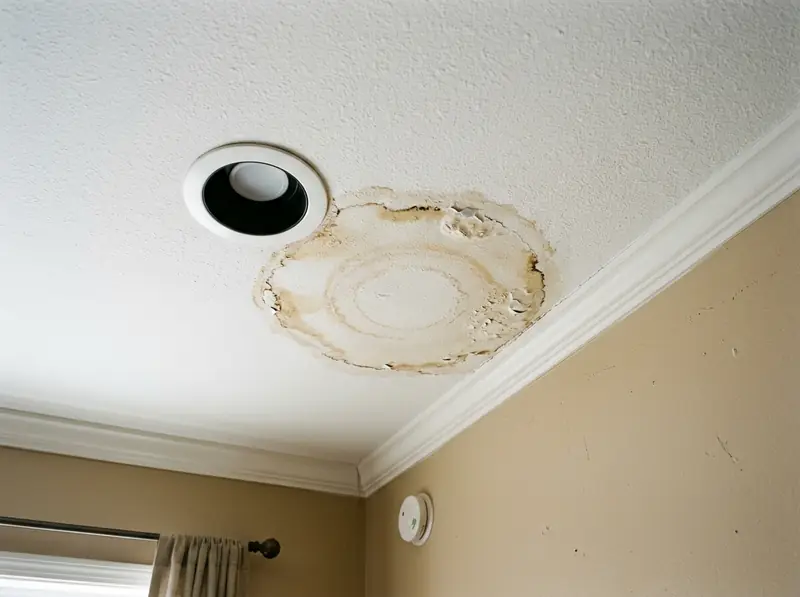
A dripping ceiling gets worse in two directions at once — the water spreads further across the drywall and insulation the longer it sits, and a saturated ceiling section gets heavier and closer to collapse the longer it's ignored. The goal in the first few minutes is to slow both of those clocks.
Move anything valuable out from under the drip
Furniture, electronics, rugs, and boxes come first — water damage to contents is usually easier to prevent than to repair after the fact.
Place a bucket or container directly under the leak
Set a towel or old sheet around it to catch splash-back. Empty it before it overflows; a full 5-gallon bucket under a steady drip can fill faster than expected overnight.
Look for a bulge or sag in the ceiling
A ceiling that's ballooning downward is holding pooled water above the drywall, and it can fail suddenly and without further warning. If a bulge is forming, relieving it in a controlled way — a small, deliberate puncture with a screwdriver or awl, aimed into a bucket held directly underneath — lets the trapped water drain in one place instead of the whole section giving way unpredictably. This is a genuinely useful move, but only when the water is not near any electrical fixture and you can do it without standing directly under the sag.
Photograph everything before you clean up
Wide shots of the room, close-ups of the ceiling stain or hole, and anything already damaged (flooring, furniture, drywall). Insurance claims are built on this kind of contemporaneous documentation, and once water is mopped up and drywall is cut away, that evidence is gone. See Storm Damage & Insurance Claims for how this documentation feeds into a claim.
Move to attic access if it's safe
If you can get to the attic without walking through standing water or wet insulation near wiring, a flashlight check can show roughly where water is entering the decking — useful information to relay to a roofer, though tracing the exact entry point is a job for a professional (see Roof Repair for how that diagnosis actually works).
Stop and Check This First: Electrical Safety Comes Before Cleanup
Water and electricity sharing the same ceiling cavity is the single most dangerous part of an active roof leak — more dangerous, in the moment, than the water damage itself.
When to Call 911, When to Call a Roofer, and When to Call Both
Most active roof leaks are a property-damage problem, not an emergency-services problem — but a few specific situations genuinely need fire department or utility response before a roofer's involvement matters at all.
Call 911 / Fire Department First If:
- The ceiling has already collapsed or looks seconds from doing so with someone still in the room.
- You smell gas.
- You see sparking or smoke near the wet area.
- The water volume suggests structural water intrusion beyond a roof leak (a burst pipe flooding a wall, for example).
Call the Electric Utility / Electrician If:
- Water is entering at the electrical service mast, weatherhead, or meter base.
- A breaker panel itself is wet — this is outside a roofer's scope entirely and needs to be de-energized by someone qualified before anyone works near it.
Call a Roofer If:
- The leak is contained and nobody is in danger.
- The priority is stopping water from continuing to enter before more damage accumulates. This is the large majority of emergency leak calls.
- TN Roofing Crew's storm dispatch line connects you with an assigned partner crew through storm response dispatch coordination.
For a storm-driven leak that hits after hours or during active weather, TN Roofing Crew connects you with an assigned partner crew through rapid storm response dispatch coordination. Your call gets triaged by severity, and a local crew reaches out to schedule mitigation as soon as conditions allow it to be done safely — which, as the next section covers, is not always the same night the leak starts.
Active Leak Right Now?
TN Roofing Crew's storm dispatch line connects you with a vetted, licensed partner crew serving Sumner County — day or night.
What Emergency Tarping Actually Does (and Doesn't Do)
Emergency tarping is temporary weather mitigation, not a repair. A tarp's job is narrow: cover an opening or damaged section well enough to keep additional rain or wind-driven moisture out until a permanent fix can be scheduled and performed correctly, in daylight, in workable weather. It is not a substitute for diagnosing and fixing whatever actually let water in.
Doesn't Happen During an Active Storm
A crew cannot safely climb onto a wet, wind-loaded roof in the middle of a thunderstorm or high-wind event — that's not a policy, it's basic fall-safety physics. Tarping typically happens once wind and precipitation drop to a safe working threshold, which sometimes means waiting until the following morning even though the leak itself started overnight.
Performs Poorly in Sustained High Wind
A tarp has to be properly battened and fastened to hold through the next round of weather; a rushed or improperly secured tarp can tear loose and make the opening worse, or become a hazard itself.
A Stopgap With a Shelf Life
A tarp left in place for weeks starts to degrade from UV exposure and wind flex, and it's never as watertight as the roof covering it's standing in for. The permanent repair should follow as soon as it can genuinely be scheduled and performed — not left indefinitely because the immediate emergency feels resolved.
What Comes Next
Once a tarp is in place and the immediate danger has passed, the follow-up is a proper diagnosis of the source and a permanent fix — see Roof Repair for how flashing, pipe boot, and valley repairs are actually diagnosed and priced (spot repairs generally run $150–$500, flashing repairs $200–$600, and valley or decking repairs $300–$1,500 depending on scope). If the leak traces back to a specific hail or wind event, that permanent repair is also the point where documenting damage for an insurance claim matters most — see Storm Damage & Insurance Claims.
What If the Leak Isn't Actually the Roof?
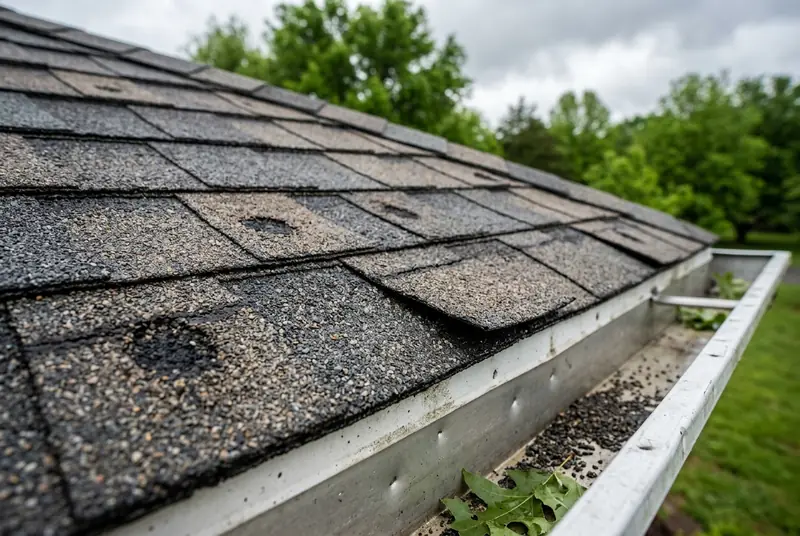
Water coming through a ceiling doesn't automatically mean roof damage — several other sources produce the same symptom, and knowing the difference before assuming a roof emergency saves a wasted dispatch call and points you to the right professional faster.
| Likely Source | Signs That Point Here | Who to Call |
|---|---|---|
| Roof leak | Stain grows or drips more during and right after rain; worse near a chimney, skylight, or vent stack; attic decking visibly wet after a storm | Roofer / TN Roofing Crew |
| Plumbing leak | Stain is directly below or near a bathroom, kitchen, or upstairs supply line; appears regardless of weather; may smell musty near a fixture | Plumber |
| HVAC condensation | Stain sits near a ductwork run or an attic-mounted air handler; worsens in summer humidity rather than during rain; often a slow, steady drip rather than storm-timed | HVAC technician |
| Ice dam backup | Appears near the eaves after a freeze-thaw cycle, with ice visible in the gutter line; water backs up under shingles rather than through an obvious hole | Roofer (mitigation) + review attic insulation/ventilation |
The single most useful diagnostic question is timing: a stain that only appears or worsens during and immediately after rainfall is almost always roof-related. A stain that shows up on a dry, sunny week points toward plumbing or HVAC condensation instead. When it's genuinely unclear, a roofer's inspection can rule the roof in or out before you call a second trade unnecessarily.
After the Leak Stops: What Happens Next
Once water intrusion is contained — by a tarp, a temporary seal, or because the rain simply stopped — three things typically need to happen in sequence: dry out the affected interior area (a fan or dehumidifier on wet insulation and drywall reduces the risk of mold setting in within 24–48 hours), schedule the permanent roof repair before the next weather system arrives, and, if the cause traces back to a specific storm, start the insurance claim process while the documentation from the first hours is still fresh.
A Building Code Note Worth Knowing
In rare cases where an emergency repair turns out to need extensive decking replacement across a large section, it's worth knowing that adopted building codes (IRC Section R908.3) prohibit installing a new roof covering over two existing layers or over saturated, deteriorated decking — something a licensed contractor will inspect and flag if a full slope replacement is required.
TN Roofing Crew connects Sumner County property owners with vetted, independently licensed and insured local roofing crews for both the emergency mitigation call and the follow-up permanent repair, so the same partner crew that tarped the roof can also be the one who fixes it for good.
Related Guides
Cost is only one piece of the puzzle. Review these related guides for the decisions that follow an emergency leak.
Roof Repair in Sumner County
How flashing, pipe boot, and valley repairs are diagnosed and priced once the emergency mitigation is done.
InsuranceStorm Damage & Insurance Claims
How your photo documentation from the first hours feeds into a covered-peril insurance claim.
Decision GuideRoof Repair vs. Replace Guide
Once the leak is stopped, decide whether a targeted repair or a full replacement is the right long-term call.
Materials & LifespanHow Long Does a Roof Last in TN?
How Tennessee heat, humidity, and storm exposure shape when a roof starts producing leaks like this one.
Frequently Asked Questions
Direct answers to the questions homeowners ask most during an active roof leak.
Generally yes, if you can reach the attic hatch without walking through standing water or wet insulation near exposed wiring, and the ceiling in that area isn't sagging or showing signs of imminent collapse. A flashlight check can help locate roughly where water is entering, which is useful information for whoever comes out to fix it.
No. A wet, storm-damaged roof is one of the more dangerous surfaces to walk on, and finding the actual entry point from the roof surface is harder than it sounds — water often travels along decking and framing before showing up somewhere else entirely. Leave that diagnosis to a professional.
It depends entirely on current weather conditions and how many other calls are ahead of yours during an active storm event — tarping can't happen safely in high wind or during active precipitation, so timing shifts with the weather window, not a fixed promise.
Most homeowner's policies cover reasonable emergency mitigation costs when the underlying damage is a covered peril (like wind or hail), and many policies actually require you to take reasonable steps to prevent further damage. Keep the invoice and your before/after photos; see Storm Damage & Insurance Claims for how that documentation fits into a claim.
There's no fixed number, but a tarp is UV- and wind-exposed from day one and degrades faster than the roofing material it's covering. Treat it as a matter of days to a couple of weeks, not a long-term solution, and schedule the permanent repair as soon as it can be done properly.
Flashing around penetrations like chimneys and skylights is one of the most common leak sources and is usually a contained, fixable repair rather than a sign of roof-wide failure — see Roof Repair for how flashing repairs are diagnosed and priced.
Active Leak? Get Connected Now.
TN Roofing Crew's storm dispatch line connects you with a vetted, licensed local crew for emergency mitigation and the permanent repair that follows.