Missing or Blown-Off Shingles: What Causes Wind Uplift & How to Determine if Your Roof Is Repairable
Finding displaced asphalt shingles on your lawn after a Middle Tennessee windstorm is a direct warning that your roof's weather barrier is broken. Wind uplift forces (often generated by 50 to 70+ mph thunderstorm gusts) exploit broken thermal adhesive sealant strips and installation fastener flaws. When a shingle blows off, exposed nail heads and permeable underlayment channel wind-driven rain straight into your attic decking within hours. Whether your roof needs a targeted $350 spot repair, a slope replacement, or a complete insurance restoration depends on one critical factor: the physical condition of the surrounding shingles during a certified brittle test.
- Aerodynamic Uplift Physics: Wind traveling across a sloped roof generates negative air pressure (suction) along ridges, eaves, and windward rakes according to Bernoulli's principle. If the factory asphalt sealant strip is compromised by age, dirt, or cold-weather installation, wind pulls the shingle tabs upward like a sail until fasteners pull through the mat.
- The Exposed Fastener Danger: When a shingle blows off, it exposes the roofing nails that secured the course below it. Rain runs down the roof plane directly into these exposed nail penetrations, bypassing the shingle overlaps and channeling water straight into the wooden roof sheathing and attic insulation.
- The "Brittle Test" Decides Repairability: To replace one missing shingle, a technician must slide a flat pry bar beneath the overlapping shingles above it and lift them 45 to 60 degrees to drive new nails into the common bond line. If those surrounding shingles are brittle from age and crack or shed granules during the lift, the roof cannot be repaired without causing collateral leaks.
- Discontinued Shingles & Matching Rules: Thousands of older 3-tab and early architectural shingles installed in Middle Tennessee subdivisions between 1998 and 2012 are now discontinued by manufacturers (e.g., GAF, CertainTeed, Owens Corning). If matching dimensions, exposure, and color are unavailable, insurance carriers are generally obligated to replace the entire directional facet under uniform appearance standards.
- 2026 Cost Benchmarks: Isolated spot repair of 1 to 3 shingles ranges from $250 to $450. Repairing a 100 sq. ft. wind-damaged patch ranges from $500 to $950. If unrepairable, full architectural replacement benchmarks at $450 to $650 per square ($13,500 to $19,500 for a typical 30-square home), typically covered by storm insurance minus your deductible.
Why Shingles Blow Off: Aerodynamic Suction & Fastener Failure
Middle Tennessee thunderstorms create turbulent, high-velocity straight-line winds that rip across residential roof planes. When shingles blow off, homeowners often wonder: was the wind unusually severe, or was the roof improperly installed? In most forensic failure investigations across Sumner County, wind damage results from a combination of adhesive bond failure and improper fastener placement.
The Wind Suction Mechanism
When wind strikes the exterior wall of a home, it is deflected upward and over the roof eave. As air accelerates over the roof peak or along the rake edges, it creates a localized drop in atmospheric pressure above the roof surface. This creates strong negative pressure — a vacuum effect that exerts continuous upward suction on the shingle tabs.
Under normal conditions, the factory-applied continuous asphalt sealant strip (activated by summer heat after installation) bonds each shingle course to the layer below it, resisting ASTM D3161 (Class F, 110 mph) or ASTM D7158 (Class H, 130 mph) wind forces. However, once age, thermal expansion, or wind buffeting breaks that sealant bond, air catches underneath the loose tab like an open parachute, generating massive leverage against the nail line.
Nail Placement & "High-Nailing"
Every architectural laminate shingle has a designated "common bond" nailing strip — a narrow zone approximately 1 to 1.5 inches wide where the decorative face laminate and the backing shim layer are bonded together. Driving 4 to 6 nails through this double-thick zone anchors both layers securely into the roof deck.
In thousands of fast-tracked subdivision builds across Gallatin, Hendersonville, and White House, inexperienced crews used pneumatic nail guns placed 2 to 3 inches too high ("high-nailing"). A high nail penetrates only the thin upper portion of the single-ply shingle, completely missing the reinforced common bond. Under moderate 45 to 55 mph gusts, the wind simply tears the unanchored face laminate right off the roof, leaving the nail heads buried uselessly underneath.
Overdriven Nails: The Hidden Failure Point
When pneumatic nail guns are calibrated with excessive compressor pressure (over 100 PSI), the head of the galvanized roofing nail punches entirely through the outer fiberglass mat. The shingle is held in place solely by surface tension rather than the nail head clamping down. During the first major windstorm, the shingle pulls cleanly over the nail heads without leaving a trace.
Wind Damage Severity Matrix: Loose Shingle to Full Blow-Off
Wind damage ranges from unsealed tabs that look normal from the ground to bare plywood decking exposed to the elements. Identify your symptom level below to determine appropriate repair protocol.
Lifted & Creased Shingles
Shingles remain on the roof but the thermal adhesive bond is broken. Wind has flapped the shingle upward, creating a faint horizontal crease line where granules have flaked off along the top edge.
- Visual Signs: Shingle tabs lift freely by hand; faint dark crease marks across tab tops.
- Water Hazard: Moderate. Driving rain can blow underneath unsealed tabs during storms.
- Repair Protocol: Hand-sealing with asphalt roof mastic or targeted shingle replacement.
Isolated Shingle Detachment
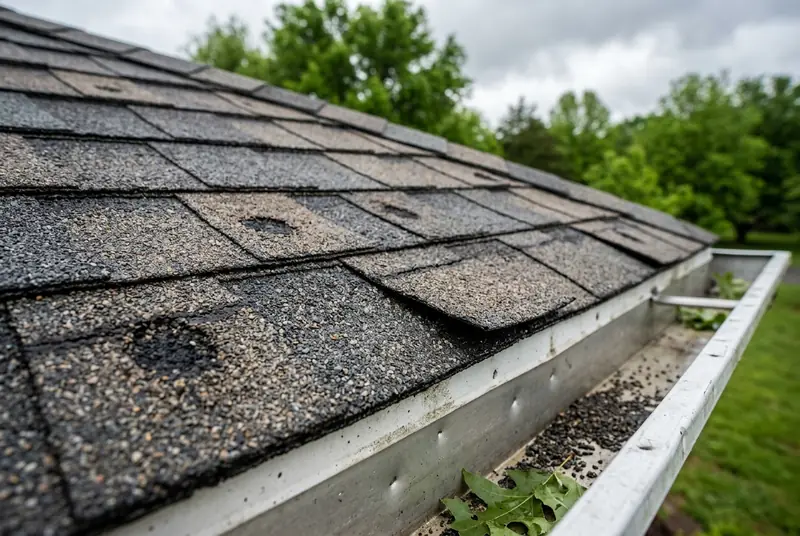
One or several shingles have torn away, leaving black asphalt underlayment or exposed nail heads visible from the ground. Displaced shingles found on the lawn or in gutters.
- Visual Signs: Rectangular black voids on roof; exposed rusty or shiny roofing nail heads.
- Water Hazard: Severe. Rain penetrates immediately around exposed fasteners.
- Repair Protocol: Immediate spot shingle replacement if surrounding shingles pass brittle test.
Widespread Blow-Off & Bare Decking
Large continuous sections of shingles have been ripped away. Underlayment is shredded or missing, exposing bare plywood or OSB decking directly to weather.
- Visual Signs: Raw wood decking visible from street; flapping torn felt; ceiling dripping.
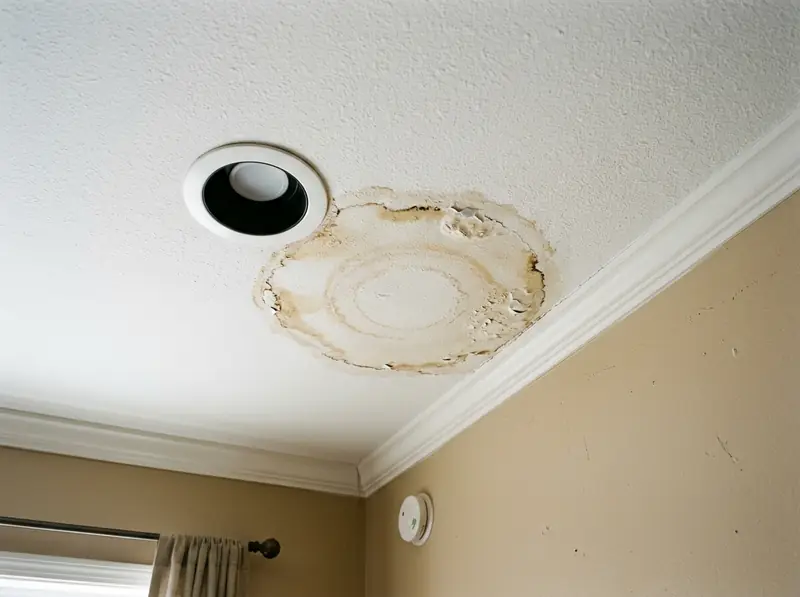
- Water Hazard: Critical. Direct water deluge into attic insulation and living space.
- Repair Protocol: Emergency storm tarping followed by full slope or complete roof replacement.
Did a recent windstorm tear shingles off your roof?
Do not leave bare underlayment exposed to Middle Tennessee rain. Vetted local partner crews provide rapid-response emergency tarping and on-roof repairability assessments across Sumner County.
The 6 Wind Failure Modes Observed on Tennessee Roofs
When roofing specialists inspect wind damage in Gallatin, Hendersonville, or Portland, they examine the exact fracture pattern of the displaced shingle. Each pattern reveals a specific aerodynamic or structural failure point.
 01
High-Nailing Mat Separation
Fasteners were driven 2 to 3 inches above the manufacturer's common bond line. When wind catches the tab, the face layer tears away while the upper strip remains attached to the deck.
 02
Oxidized Sealant Strip Failure
Middle Tennessee's 95°F+ summer attic heat causes the asphaltic adhesive line to dry out and oxidize over 12 to 15 years. Once the adhesive bond fails, standard 40 mph gusts lift tabs effortlessly.
03Starter Course Edge Delamination
If starter shingles were omitted along the eave or rake overhang, or if drip edge was unsealed, wind gets underneath the first shingle course and rolls the roof upward like a carpet.
 04
Blown-Off Ridge Cap Shingles
Ridge caps sit at the highest point of aerodynamic pressure. Using standard short nails that fail to penetrate 3/4″ into the roof framing causes entire sections of cap shingles to blow away.
05Overdriven Nail Head Pull-Through
Nail gun pressure was set too high during installation, cutting the nail head through the outer shingle mat. The shingle blows off intact, leaving circular holes where nails pulled through.
06Wind-Creased Shingle Tabs
Strong gusts lift the shingle tab repeatedly, bending the fiberglass backing until it snaps along a horizontal line. Granules flake away along the crease, allowing water infiltration during future storms.
The "Brittle Test" & Tennessee Shingle Matching: Can It Be Repaired?
Homeowners frequently assume that if only 3 or 4 shingles blew off, a simple $300 spot repair will solve the issue. However, whether a roof can actually be repaired depends on engineering physics and material availability.
The Forensic Brittle Test Protocol
To install a replacement shingle, a technician cannot simply slide it in. The overlapping shingles in the two courses directly above the missing piece must be unsealed with a pry bar, lifted upward to a 45-to-60-degree angle, and held while a hammer drives 4 to 6 new galvanized roofing nails through the common bond line.
If the existing roof is more than 12 to 15 years old, the dried asphalt bitumen has lost its elastic polymers. When the surrounding shingles are bent upward, they crack across the top, tear at the nail holes, or lose their surface granules. If performing the repair creates new structural fractures in the adjacent shingles, the roof has officially failed the brittle test and is classified as mechanically unrepairable.
Discontinued Shingles & ITEL Testing
Over the past two decades, shingle manufacturers have redesigned dimensional profiles, metric exposures, and color granules. Famous products like CertainTeed Horizon, Owens Corning Prominence, and early English-dimension 3-tab shingles are completely discontinued.
When an exact physical match is unavailable, a technician removes a shingle sample and sends it to ITEL Laboratories for independent testing. If ITEL confirms the product is obsolete and no compatible replacement exists that bonds to the existing roof system, Tennessee insurance standards and policy language generally require the carrier to replace the entire directional slope or the entire roof to restore uniform appearance and waterproof integrity.
The "Caulk and Smear" Trap: Why DIY Patching Fails
Homeowners or unlicensed handymen often attempt to repair wind-blown shingles by smearing roof tar, silicone caulk, or liquid rubber directly over the exposed gap. This traps moisture beneath the patch, rots the surrounding wood decking, and prevents proper water-shedding along the shingle lap line. Furthermore, when an insurance adjuster inspects a roof with improper DIY tar patches, they frequently cite "unworkmanlike repair" and deny storm coverage for subsequent leaks.
Unsure if your missing shingles can be spot-repaired?
Schedule a comprehensive on-roof assessment. Assigned licensed inspectors perform brittle testing, identify discontinued shingle lines, and provide photo documentation for you or your insurance adjuster.
Cost Benchmarks: Spot Repairs, Slope Replacements & Full Tear-Offs
Transparent, itemized pricing for wind damage repairs across Sumner County residential properties. All benchmarks reflect 2026 Middle Tennessee labor and material averages.
| Scope of Work | Price Benchmark | What Is Included | Insurance Applicability |
|---|---|---|---|
| Isolated Spot Shingle Repair | $250 – $450 | Replacement of 1 to 3 blown-off shingles, sealing surrounding tabs | Usually below deductible; paid out of pocket by homeowner |
| Moderate Wind Patch (1 Bundle) | $450 – $750 | Replacing up to 33 sq. ft. of blown-off shingles, underlayment reseal | Paid out of pocket or grouped into comprehensive storm claim |
| Emergency Tarping (Up to 500 sq. ft.) | $350 – $650 | Heavy-duty 10-mil tarp, 2x4 furring strips, sealed deck perimeter | 100% reimbursable under insurance "Reasonable Emergency Repairs" |
| Single Directional Slope Replacement | $450 – $600 / square | Full tear-off of windward slope, synthetic felt, matching shingles | Covered by carrier when damage is concentrated and roof is matchable |
| Full Roof Replacement (Architectural) | $450 – $650 / square | Complete tear-off, 6-ft ice & water shield, new drip edge, pipe boots | Standard storm claim approval when brittle test fails or shingle obsolete |
| Plywood / OSB Decking Replacement | $65 – $95 / sheet | 4'x8' CDX plywood or OSB replacement for rotted sheathing boards | Covered if rot was caused by sudden storm damage during claim window |
Multi-Slope Damage & IRC R908.3 Recover Limits
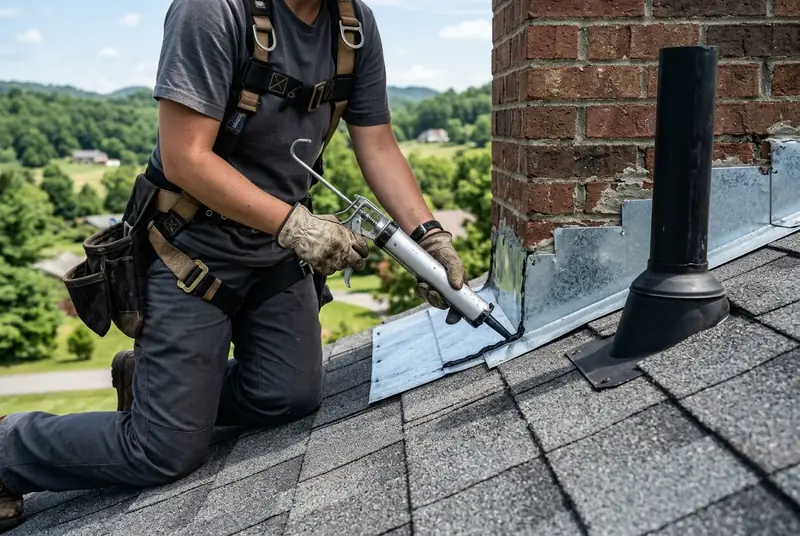
Under adopted International Residential Code provisions (IRC Section R908.3) enforced across Sumner County municipalities, a new roof covering cannot be installed over water-soaked or deteriorated decking or where two layers of roofing already exist. In addition, when wind creasing or missing shingles exceed roughly a quarter of a roof slope or adjacent tabs fail brittle testing, insurance adjusters and roofing contractors typically scope a full slope or full roof replacement rather than patchwork repairs.
Emergency Action: 4 Steps When Shingles Blow Off Your Roof
Taking decisive action within the first 24 hours prevents a $350 shingle repair from escalating into a $10,000 interior drywall and mold remediation project. Follow these four professional containment steps.
Inspect From the Ground
Walk the perimeter of your home and photograph any displaced shingles on the lawn. Look up at roof ridges, eaves, and valleys with binoculars. Never climb onto a wet, storm-damaged roof yourself.
Check the Attic Space
Enter the attic with a high-powered flashlight. Inspect the underside of the roof rafters and OSB decking directly below the area where shingles are missing. Check for damp wood, drips, or daylight shining through.
Secure Emergency Tarping
If rain is forecasted before a permanent repair can occur, have a licensed crew install a heavy-duty synthetic tarp anchored with 2×4 furring strips screwed through the ridge. Never nail through the center of field shingles.
Perform Repairability Check
Have a qualified roofing specialist evaluate the surrounding shingles for brittleness and check manufacturer databases for product discontinuation before submitting an insurance claim.
Common Questions on Missing Shingles, Wind Damage & Repairs
Objective answers regarding wind uplift damage, shingle replacement mechanics, and Tennessee homeowners insurance guidelines.
Only if the surrounding shingles are supple enough to withstand being lifted without cracking, and only if an exact physical dimension and profile match is available. Replacing a shingle requires lifting the two courses above it, extracting the damaged nails from the wooden deck with a cat's paw, sliding the new shingle into place, nailing through the double-layer common bond zone, and hand-sealing the tabs with asphalt roofing mastic. If done incorrectly, nailing through the face of the shingle creates open leak points.
It is very likely to leak during the next moderate or heavy rainstorm. Even though black synthetic or felt underlayment covers the wood decking, the roofing nails that secured the missing shingles remain embedded in the deck. Rain running down the slope catches against these nail shanks and seeps directly through the puncture holes in the underlayment. Furthermore, standard felt underlayment is water-resistant, not waterproof, and degrades quickly when exposed to sunlight and wind.
Yes. Wind damage caused by thunderstorms, high wind gusts, or tornadoes is covered under standard Tennessee homeowners policies as a sudden and accidental peril. However, coverage depends on your policy's wind/hail deductible (often 1% to 2% of dwelling coverage, or $3,000 to $6,000). If only a few shingles blew off and the roof can be spot-repaired for $350, filing a claim makes no financial sense. If widespread shingles are missing or the roof fails the brittle test — requiring a full slope or full roof replacement — filing an insurance claim is fully justified.
Wind creasing occurs when high-velocity wind breaks the shingle's thermal sealant strip and repeatedly folds the shingle tab upward without completely tearing it off the deck. This bending action snaps the internal fiberglass reinforcement mat, creating a permanent horizontal line across the upper edge of the shingle where ceramic granules flake off. Wind-creased shingles are classified by certified insurance adjusters and Haag engineering standards as functionally damaged and qualifying for replacement.
Certified adjusters and roofing specialists perform a standardized "repairability" or "brittle" test on-site. The inspector gently lifts an unsealed shingle adjacent to the damaged area to a 45-degree angle (the minimum height required to swing a roofing hammer and drive nails). If the shingle cracks, snaps, tears, or sheds excessive granules along the bend line, the shingle is documented as non-repairable. The adjuster then includes slope or full roof replacement in the insurance scope.
Take dated photos of the displaced shingles on the lawn and wide-angle photos of the roof showing the missing sections. Next, check your attic insulation for signs of active moisture intrusion. Finally, call a reputable local roofing contractor to perform an on-roof evaluation and install emergency tarping if rain is impending. Emergency tarping costs are classified as "mitigation of loss" and are reimbursable by your insurance company.
Schedule Your Missing Shingle & Wind Damage Inspection
Connect with vetted, independently licensed Middle Tennessee roofing specialists. Receive rapid emergency tarping, an objective brittle repairability assessment, and detailed insurance documentation.