Do reflective roof coatings really cut cooling costs in Tennessee summers? See what they can and cannot do, then call (615) 647-8320 for honest advice.
Yes, cool roof coatings work exceptionally well in Tennessee, but their effectiveness depends heavily on the specific roofing substrate. Fluid-applied high-solids silicone and acrylic elastomeric coatings (tested under ASTM D6694) are engineered for commercial low-slope flat roofs and pre-engineered metal buildings — reflecting up to 85% to 88% of solar radiation and lowering rooftop surface temperatures from 165°F down to 95°F during Middle Tennessee summer heatwaves. However, cool roof coatings should never be applied to residential asphalt shingles, as doing so voids shingle warranties, seals natural moisture escape paths, and creates unsightly cosmetic peeling.
The Physics of Cool Roof Technology: Solar Reflectance & Thermal Emittance
To evaluate how cool roof coatings combat Middle Tennessee's intense summer heat, examine the two primary thermodynamic metrics defined by the Cool Roof Rating Council (CRRC):
- Solar Reflectance Index (SRI): The fraction of solar energy reflected away from the roof surface before it can be absorbed as heat. Standard dark gravel-surfaced built-up roofs or black EPDM membranes absorb up to 90% of solar radiation, resulting in surface temperatures exceeding 160°F to 175°F. High-solids white silicone coatings possess an SRI of 110+, reflecting up to 88% of solar rays.
- Thermal Emittance: The efficiency with which a roof radiates absorbed heat back into the atmosphere rather than conducting it downward into building insulation. High-solids silicone coatings feature thermal emittance ratings above 0.90, rapidly discharging ambient heat during nighttime hours.
Why Cool Roof Coatings Excel on Commercial & Metal Decks
For commercial property managers, industrial plants in Gallatin and Portland, and retail strip centers in Hendersonville, White House, and Goodlettsville, fluid-applied roof restorations deliver substantial operational benefits:
- 01
Dramatically Lower HVAC Energy Consumption
By reducing rooftop surface temperatures from 165°F down to 95°F, rooftop air conditioning condenser units (RTUs) draw significantly cooler ambient intake air. This reduces compressor strain, prevents high-pressure head trip-outs, and cuts commercial summertime electrical utility costs by 15% to 25%.
- 02
Seamless Monolithic Waterproofing
Commercial silicone coatings are applied as a continuous, seamless liquid membrane (typically 25 to 30 dry mils thick) across existing aged modified bitumen, single-ply, or metal panel roofs. The seamless coating encapsulates all seams, rivets, fasteners, and flashing details, eliminating seam failures.
- 03
Permanent Resistance to Ponding Water
Unlike older water-based acrylic coatings that re-emulsify and dissolve under standing water, high-solids silicone is a moisture-cure thermoset polymer that is completely impervious to continuous ponding water.
- 04
Substantial Cost Savings vs. Full Tear-Off
Restoring an existing commercial roof with a fluid silicone coating system costs approximately 40% to 50% less than a complete tear-off and replacement. Furthermore, commercial roof coatings are classified as maintenance expenses, allowing full tax deductions in the year installed.
Technical Comparison of Commercial Roof Coating Chemistry
Review the performance characteristics across common commercial fluid-applied systems:
| Coating Chemistry | Solar Reflectance (SRI) | Ponding Water Resistance | Tensile Strength & Elongation | Recommended Application |
|---|---|---|---|---|
| High-Solids 100% Silicone ASTM D6694 Specification | Very High (SRI 110+) | Exceptional (Impervious to standing water) | High flexibility; withstands building movement | Commercial low-slope roofs, aging single-ply, flat metal |
| Water-Based Acrylic Elastomeric ASTM D6083 Specification | High (SRI 100 – 105) | Poor (Re-emulsifies under ponding water) | High tensile strength; UV reflective | Positively sloped commercial metal roofs without ponding |
| Polyurethane Coating Aromatic Base + Aliphatic Top | Moderate to High | Good (Tolerates moderate moisture) | Exceptional impact & abrasion resistance | High foot-traffic rooftop access paths, industrial decks |
| Aluminum Flake Asphalt Traditional solvent-based paint | Low to Moderate (SRI 60 – 70) | Fair (Short-lived protection) | Rigid; cracks under thermal expansion | Temporary reflective maintenance on smooth modified bitumen |
Why Cool Roof Coatings Should Never Be Applied to Residential Shingles
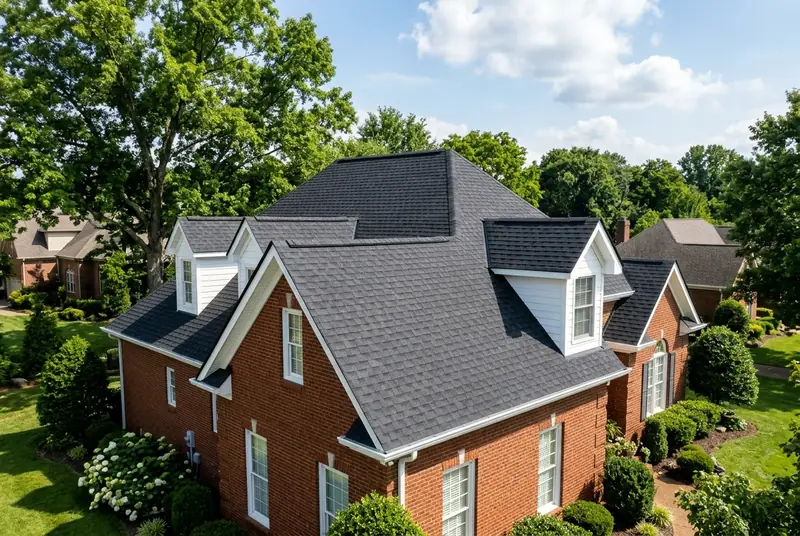
Homeowners are frequently targeted by deceptive marketing campaigns promoting "liquid roof shingle rejuvenation" coatings. Reputable licensed roofing contractors in Tennessee strongly advise against coating residential asphalt shingles:
Asphalt shingles are designed as a breathing, layered water-shedding system, not a monolithic waterproof membrane. Coating shingles with elastomeric paint glues the tabs together, blocking essential drainage channels between individual shingles and trapping moisture inside wood decking beneath.
Furthermore, coating asphalt shingles immediately voids all existing manufacturer warranties (including GAF, Owens Corning, and CertainTeed). When the coating inevitably blisters, cracks, and peels under Middle Tennessee's intense summer heat, the roof cannot be repaired — it must be completely torn off at substantial expense.
Commercial Asset Management & Warranty Renewal Protocols
For commercial facility managers across Sumner County, fluid-applied roof coatings provide a predictable, renewable asset maintenance strategy:
- Non-Prorated Manufacturer Warranties: Certified commercial applicators register 10-year, 15-year, or 20-year No Dollar Limit (NDL) material and labor warranties through leading coating manufacturers (such as Gaco, Henry, or Mule-Hide).
- Renewable Life-Cycle Model: Unlike single-ply membranes that must be completely torn off when worn, silicone roof coatings can be washed and re-applied every 15 to 20 years, effectively creating an indefinite roof life without future tear-off disruption.
- Infrared Thermal Scanning Mandate: Before applying any fluid coating, a certified technician conducts an infrared thermographic scan at night to pinpoint and excise saturated insulation cores, ensuring the substrate is 100% dry.
- Environmental Waste Diversion: Coating an existing commercial roof diverts tons of non-biodegradable roofing waste away from Sumner County landfills, aligning with corporate sustainability initiatives.
Frequently Asked Questions About Cool Roof Coatings
A properly applied 25-to-30-dry-mil high-solids silicone coating typically provides 15 to 20 years of watertight protection, backed by manufacturer material and labor warranties. When the warranty period expires, the roof can simply be power-washed and re-coated with a fresh topcoat, renewing the warranty for another 10 to 15 years without tear-off.
Yes. Commercial roof coatings and restorations are classified as re-roofing projects that require municipal commercial building permits in Hendersonville, Gallatin, White House, Goodlettsville, and Portland. The contractor must perform thermal moisture scans to verify that underlying wet insulation is removed prior to coating application.
Yes, provided the metal is mechanically prepped first. Severe surface rust is wire-brushed or power-washed to remove loose scale, loose screws are replaced with oversized fasteners, and a rust-inhibiting primer is applied before coating the metal with high-solids silicone.
Next Steps & Related Roofing Guides
Related Sumner County Roofing Guides: Continue reading Architectural vs. 3-Tab Shingles: Is the Upgrade Worth It? and Standing Seam vs. Corrugated Metal Roofing in Tennessee.