Standing seam can last 45-60+ years while screw-down panels need gasket care. Compare cost and lifespan, then price your roof: (615) 647-8320.
Standing seam metal roofing lasts significantly longer than exposed-fastener corrugated metal roofing in Tennessee — providing 45 to 60+ years of maintenance-free service life compared to 20 to 25 years for corrugated screw-down panels. The primary failure mechanism of corrugated metal roofs is thermal expansion: metal panels expand and contract in Tennessee's 100°F annual temperature swings, causing thousands of exposed neoprene rubber screw washers to crack, back out, and leak after 7 to 10 years. In contrast, standing seam utilizes concealed clips and raised interlocking seams that allow frictionless thermal movement with zero exposed screw penetrations.
The Critical Engineering Difference: Concealed Fasteners vs. Exposed Screws
While both standing seam and corrugated metal roofs utilize steel substrates coated with aluminum-zinc alloys (Galvalume), their mechanical fastening systems represent completely different tiers of engineering:
- 01
The Exposed Fastener Vulnerability (Corrugated / Screw-Down)
Corrugated metal roofs (including 5V-crimp, R-panel, and ribbed agricultural panels) are secured by drilling thousands of screws directly through the face of the metal into wood decking or purlins. An average residential roof requires between 3,000 and 5,000 through-panel screws. Each screw relies on a small rubber neoprene gasket washer to prevent water entry.
- 02
Thermal Expansion & Washer Degradation in Middle Tennessee
Steel expands in summer heat (reaching 160°F+ on rooftops) and contracts during winter freezes. A 30-foot metal panel expands up to 1/4 inch during daily temperature cycling. Over time, this constant mechanical movement elongates the screw holes and tears the rubber washers. Furthermore, Middle Tennessee ultraviolet sunlight and ozone degrade neoprene rubber, causing washers to dry rot, crack, and fail within 7 to 10 years, necessitating costly whole-roof screw replacement.
- 03
The Standing Seam Concealed Clip Solution
Standing seam roofing panels feature vertical ribs measuring 1.5 to 2.0 inches in height. Panels are held to the roof deck using concealed stainless steel or coated clips hidden inside the seam. The adjacent panel snaps over the clip or is mechanically seamed with a robotic seamer tool.
- 04
Frictionless Floating Movement
Because all fasteners are concealed beneath raised interlocking seams, the panels float freely along their length as temperatures fluctuate. There are zero exposed screw penetrations across the field of the roof, completely eliminating the primary leak mechanism that plagues screw-down corrugated panels.
Technical Comparison: Standing Seam vs. Exposed Fastener Corrugated
The table below contrasts the material specifications, maintenance requirements, and life-cycle costs of both metal roofing systems:
| Engineering Attribute | Standing Seam Metal (Concealed Clip) | Exposed Fastener Metal (Screw-Down) | Performance Advantage |
|---|---|---|---|
| Installed Cost Per Square | $900 – $1,450 per square | $550 – $850 per square | Corrugated is cheaper upfront; standing seam is lowest life-cycle cost |
| Steel Gauge Thickness | Heavy 24-Gauge (0.024") standard | Thinner 29-Gauge or 26-Gauge | Standing seam resists severe hail and heavy foot traffic |
| Fastener Configuration | 100% Concealed clips & seam locks | 3,000 – 5,000 exposed screws through metal | Standing seam eliminates 3,000+ potential leak penetration points |
| Fastener Maintenance Cycle | Zero routine fastener maintenance | Inspect/replace screws every 7 – 10 years | Corrugated requires $1,500–$3,500 periodic screw re-torquing |
| Factory Protective Finish | Full PVDF (Kynar 500 / Hylar 5000) | Siliconized Modified Polyester (SMP) | Kynar 500 finish resists fading and chalking for 40+ years |
| Expected Service Lifespan | 45 – 60+ Years in Tennessee | 20 – 25 Years (With maintenance) | Standing seam lasts more than twice as long as corrugated |
| Minimum Roof Slope | Down to 2:12 (or 1/2:12 with sealant) | Minimum 3:12 slope required | Standing seam can be installed on low-pitch porches and entries |
Middle Tennessee Applications: Waterfront Luxury vs. Rural Storage
Understanding the appropriate application for each metal roofing system helps Sumner County property owners make sound investments:
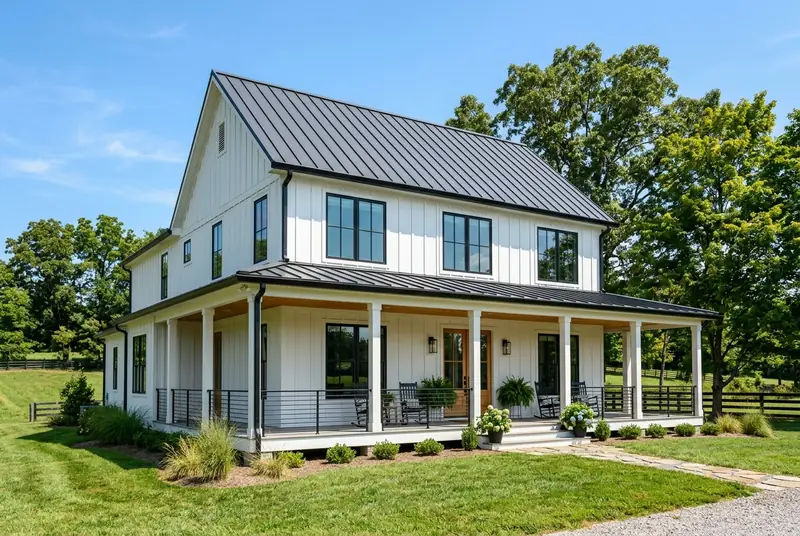
Standing seam metal is the premier architectural choice for primary residential homes, luxury waterfront properties along Old Hickory Lake in Hendersonville, and high-end residential estates in Gallatin. Its clean vertical lines, concealed fasteners, and 50+ year lifespan complement transitional, modern farmhouse, and traditional architectures while satisfying stringent HOA guidelines.
Exposed fastener corrugated metal roofing is highly practical and cost-effective for detached agricultural barns, equipment sheds, detached garages, and workshop outbuildings in rural Sumner County communities like Portland and White House, where periodic screw maintenance is manageable and upfront capital expense is the primary consideration.
Architectural Trim Detailing & Gutter Integration
The long-term performance of a metal roof depends heavily on perimeter trim fabrication and rain diversion engineering:
- Custom On-Site Metal Pan Forming: Premium standing seam contractors utilize mobile roll-forming machines to fabricate continuous single-length panels on-site, eliminating horizontal lap seams even on 40-foot roof slopes.
- 24-Gauge Galvalume Substrate Integrity: Using heavy 24-gauge steel coated with aluminum-zinc alloy (AZ-50 or AZ-55) provides structural dent resistance against falling tree limbs and hail, preventing the visible dimpling common on thin 29-gauge agricultural metal.
- Heavy-Capacity Seamless Guttering: Metal roofs shed storm runoff significantly faster than rough asphalt shingles. Installing 6-inch seamless aluminum or commercial copper gutters with heavy-duty hidden hangers ensures high-volume spring downpours are safely diverted away from home foundations.
- Snow Guards for Eaves & Walkways: On steep metal roofs, installing color-matched snow guards prevents accumulated winter snow and ice sheets from sliding off in avalanches above entry doors and garage walkways.
Frequently Asked Questions About Metal Roofing
No. On a residential home, metal panels are installed over solid 7/16" OSB or 1/2" CDX plywood sheathing, continuous synthetic underlayment, and deep attic insulation (R-38 to R-49). This solid building envelope absorbs acoustic sound waves, making rain noise virtually indistinguishable from an asphalt shingle roof.
Yes. Mechanically seamed standing seam panels with factory-applied in-seam butyl sealant can be safely installed on slopes as low as 1/2:12 or 2:12. This makes standing seam the ideal architectural solution for low-pitch front porches, sunrooms, and rear patio additions where asphalt shingles would fail.
No. Lightning strikes the highest geographic point in an area regardless of material composition. A metal roof does not increase lightning strike probability. In fact, because metal is non-combustible (Class A fire rated), if lightning were to strike, the metal roof safely disperses the electrical energy without igniting roof framing.
Next Steps & Related Roofing Guides
Related Sumner County Roofing Guides: Continue reading Architectural vs. 3-Tab Shingles: Is the Upgrade Worth It? and Class 4 Impact-Resistant Shingles: Are They Worth the Cost?.