Hail Dents on Gutters & Vents: How Soft Metal Proves Hidden Roof Damage & Insurance Eligibility
If a Middle Tennessee hailstorm leaves visible dimples on your seamless aluminum gutters, downspouts, or rooftop box vents, your asphalt shingles almost certainly absorbed the identical kinetic impact. Because thin aluminum (.027″ to .032″) deforms at lower kinetic energy than shingles, soft metal damage serves as primary forensic proof establishing storm date and trajectory. While shingles rarely show obvious ground-level holes immediately, underlying fiberglass mats crack and shed mineral granules — creating slow water intrusion pathways that insurers cover when documented within policy filing windows.
- Collateral Evidence Rule: Soft aluminum gutters, downspouts, furnace caps, and AC condenser fins are classified as "collateral evidence." Insurance adjusters inspect these soft metals first to verify hail size, storm direction, and date of loss before evaluating shingles.
- Hidden Shingle Mat Bruising: Hailstones that dent gutters crush the mineral granule layer into the asphalt bitumen and rupture the interior fiberglass mat. While this does not cause an immediate waterfall in your living room, the compromised mat allows ultraviolet light and rain to accelerate rot and trigger leaks within 12 to 24 months.
- The 10×10 Test Square Standard: Insurance adjusters chalk a 10-foot by 10-foot square on each directional slope (north, south, east, west). Finding 8 to 10 qualified hail strikes within that 100-square-foot square generally triggers full directional slope or complete roof replacement approval.
- Cosmetic Metal vs. Functional Roof Damage: Some Tennessee homeowner policies carry cosmetic damage exclusions on metal gutters and siding. However, asphalt shingle mat fractures are classified as functional physical damage that impairs water-shedding performance and cannot be excluded under cosmetic clauses.
- Tennessee Wind/Hail Deductibles: Many homeowner policies carry a policy-specific percentage or flat wind/hail deductible (for example, an illustrative 1% to 2% deductible equals $3,000 to $6,000 on a $300,000 dwelling limit, depending on carrier underwriting). Verifying collateral damage before filing avoids paying deductibles on non-qualifying claims.
Why Gutters Dent Before Shingles Show Ground-Level Leaks
Homeowners across Hendersonville, Gallatin, and White House frequently look up at their roofs after a severe convective storm and assume the roof is untouched because shingles are not visibly missing. Meanwhile, their aluminum gutters look like they were hit with a ball-peen hammer. Understanding the distinct material response between ductile aluminum and composite asphalt explains why gutter dents are the earliest warning sign of roof failure.
Plastic Deformation in Soft Aluminum
Residential seamless gutters are extruded from roll-formed aluminum coils typically .027 inches thick (standard residential grade) or .032 inches thick (heavy-duty commercial grade). Aluminum is a ductile metal with high malleability. When a hailstone traveling at terminal velocity strikes the gutter lip or face, the kinetic energy ($KE = \frac{1}{2}mv^2$) immediately exceeds the yield strength of the thin metal.
The metal deforms plastically — meaning it permanently stretches and indents rather than springing back. Furthermore, when hailstones hit oxidized paint on downspouts and gutters, they create distinct "spatter marks" where the oxidized chalk film is scrubbed clean by the ice impact. These spatter marks provide undeniable mathematical evidence of the hailstone's exact physical diameter, angle of descent, and wind trajectory.
Sub-Surface Fracturing in Asphalt Shingles
An asphalt architectural shingle is a composite laminate composed of three distinct layers: a woven fiberglass backing mat, an asphaltic bitumen waterproofing core, and an armor layer of ceramic-coated mineral granules. Unlike aluminum, asphalt shingles are visco-elastic. When struck by hail, the flexible shingle mat compresses downward into the plywood decking and springs back up.
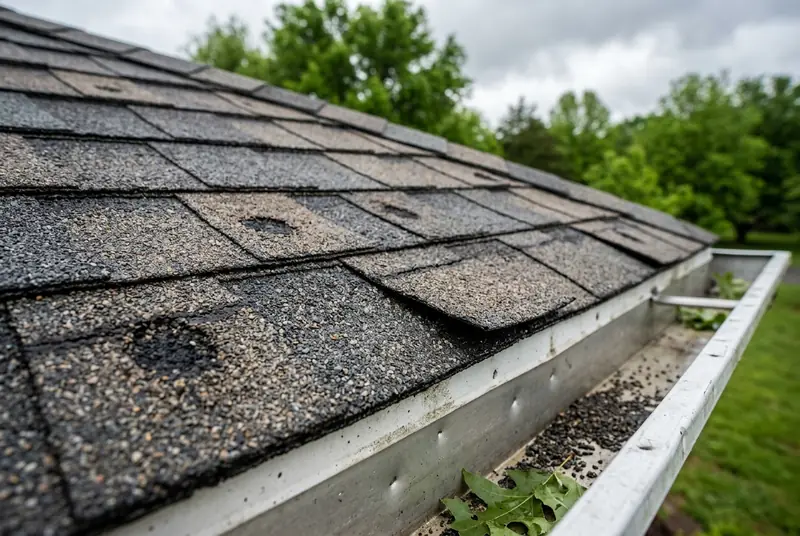
However, the rapid shockwave crushes the mineral granules into the asphalt core, breaking the chemical bond. More critically, the tensile stress on the bottom surface of the shingle tears the brittle fiberglass fibers, producing a localized "bruise" or starburst fracture. From your driveway 20 to 30 feet below, a bruised shingle looks dark and completely intact. But on the roof surface, the protective seal is shattered.
The Ground-Level Vantage Fallacy
Viewing a 6/12 or 8/12 pitch roof from the ground compresses the visual angle. You are viewing the shingle edges and shadow lines rather than the flat exposure face where hailstones land perpendicular to the slope. If your gutters have 15 or 20 distinct dents along a 30-foot run, the roof facet directly above that gutter took between 80 and 150 hailstone impacts across the same surface area.
Hailstone Sizing Matrix: Impact Velocity vs. Damage Severity
Damage severity depends on hail diameter, density, fall velocity, and storm wind speed. Use this forensic triage matrix to correlate observed gutter dents with probable shingle mat compromise.
Pea to Marble Sized Hail
Typical fall velocity of 10 to 25 mph. Generates minimal kinetic energy. Capable of removing oxidized chalk from gutter paint and dislodging loose, unbonded granules on older roofs.
- Soft Metal Impact: Tiny surface spatter marks; no structural gutter creasing.
- Roof Impact: Fiberglass mat remains 100% intact; zero structural puncture.
- Adjuster Outcome: Unlikely to meet insurance claim approval thresholds.
Dime to Quarter Sized Hail
Fall velocity of 35 to 50 mph. Kinetic energy reaches the critical fracture threshold for residential fiberglass mats. Generates clear, permanent indentations on soft aluminum.
- Soft Metal Impact: Distinct coin-sized dents on gutter bottoms, face, and box vents.
- Roof Impact: Shingle bruising, circular granule displacement, fractured fiberglass mats.
- Adjuster Outcome: High probability of directional slope or full roof replacement approval.
Golf Ball to Baseball Sized Hail
Fall velocity of 60 to 85+ mph. Severe kinetic energy impact. Crushes gutter profiles, tears metal seams, shatters fiberglass shingle substrates, and splits cedar or vinyl accessories.
- Soft Metal Impact: Heavy gutter creasing, crushed vent domes, smashed AC cooling fins.
- Roof Impact: Punctured shingles, exposed bare asphalt/decking, cracked ridge vents.
- Adjuster Outcome: Immediate total roof and gutter system replacement approval.
Did a recent storm leave visible dents on your gutters or downspouts?
Do not wait for water stains to appear on your ceiling. Assigned licensed Sumner County roofing specialists climb the roof, chalk test squares, and take date-stamped macro photos to verify whether your property meets insurance replacement criteria.
The 6 Collateral Metal Indicators Adjusters Require
Insurance field adjusters are trained not to climb straight onto the roof shingles. Instead, standard forensic inspection procedure dictates walking the building perimeter at ground level first. They inspect six specific soft metal indicators to corroborate storm activity and determine windward impact trajectories.
 01
Seamless Aluminum Gutters & Downspouts
Adjusters look for concave circular depressions along the upper gutter lip and front face. On downspouts, they look for horizontal impact rings and spatter marks that remove surface oxidation.
02Rooftop Box Vents & Turtle Hoods
Aluminum attic exhaust vents sit elevated on the roof plane with zero tree protection. Hail impacts leave permanent craters in the dome caps and can break the perimeter waterproof seal where flashing meets shingles.
 03
Furnace & Water Heater Rain Caps
B-vent flue pipes extending through the roof are made of light galvanized steel or aluminum. Impact indentations on the conical top cap confirm direct vertical and windward hail strikes.
04Outdoor AC Condenser Radiator Fins
Outdoor HVAC units have ultra-thin aluminum heat exchange fins. Wind-driven hail flattens and bends these delicate fins, creating a clear visual signature that adjusters photograph on almost every hail claim.
05Aluminum Eave Drip Edge & Fascia
The L-shaped aluminum drip edge running beneath the starter shingles along the roof perimeter deforms under direct hits, creating scalloped edges and proving impact force directly adjacent to the shingles.
06Open Metal Valleys & Ridge Caps
In homes with open metal valley flashing, heavy hail leaves distinct gouges and dents along the drainage channel. On hips and ridges, the bent profile of ridge cap shingles leaves them especially vulnerable to fractured backing mats.
Shingle Bruising vs. Manufacturing Blisters: How Experts Test the Mat
Insurance companies routinely hire third-party engineering firms or independent adjusters who attempt to attribute shingle damage to non-storm factors like blistering, foot traffic scuffing, or natural aging. Knowing how certified Haag inspectors conduct physical testing ensures your legitimate storm claim is defended.
The Tactile Thumb-Press Test
A genuine hail strike is diagnosed through tactile examination, not visual inspection alone. When an inspector spots a circular area of dark, missing granules, they press the pad of their thumb firmly into the center of the mark.
If the underlying fiberglass mat has ruptured, the center feels soft, spongy, and resilient — similar to pressing a bruised apple. The asphalt core has separated from the fiberglass reinforcement. If the spot feels hard, rigid, and solid against the decking, the granule loss is often surface wear or an unpopped blister rather than a structural fracture.
Differentiating Blisters from Hail Hits
Asphalt shingles naturally develop "blisters" when trapped moisture or volatile oils vaporize inside the shingle during Middle Tennessee's intense summer heat waves. Blisters pop from the inside out, leaving a hollow crater with a brittle, raised volcanic rim. Crucially, blisters appear randomly across all roof slopes, including sheltered areas under eaves.
Hail damage, by contrast, is an external downward impact. Hail hits show compacted granules pressed downward into the asphalt bitumen, with broken fiberglass filaments visible under a 10× jeweler's loupe. Most importantly, hail strikes align with the wind direction of the storm and correlate with dented gutters and soft metal collateral.
Why Delayed Hail Leaks Catch Homeowners Off Guard
A bruised shingle rarely leaks the night of the hailstorm. However, once the protective ceramic granules are stripped away, the raw black asphalt bitumen is exposed to solar UV radiation. Within 12 to 18 months, thermal expansion and UV exposure cause the exposed asphalt to dry, oxidize, crack, and erode down to the bare fiberglass backing. Rainwater then penetrates directly through the cracked mat into the roof decking, causing extensive rot long after the storm's filing window has closed.
Don't let your insurance claim filing window expire.
Most Tennessee homeowner policies require wind and hail claims to be initiated within roughly one year of the documented Date of Loss. If you wait until water enters your home, insurers can deny coverage under long-term maintenance and neglect exclusions.
Cost Benchmarks: Gutter Repairs, Shingle Replacement & Deductibles
Whether paying out of pocket or navigating an insurance claim, having transparent unit pricing is essential. Here are realistic 2026 pricing benchmarks for Middle Tennessee residential properties.
| Scope Item | Unit Cost Range | Typical Residence Scope | Insurance Claim Status |
|---|---|---|---|
| 5″ Seamless Aluminum Gutters | $8 – $11 / linear ft | $1,600 – $2,200 (200 linear ft) | Covered if dented (unless policy has cosmetic metal waiver) |
| 6″ Heavy-Gauge Aluminum Gutters | $11 – $14 / linear ft | $2,200 – $2,800 (200 linear ft) | Covered; recommended upgrade for steep pitches and valley runoff |
| Rooftop Box Vents / Turtle Vents | $150 – $300 each | $450 – $1,200 (3 to 5 units replaced) | Standard RCV claim item; includes detached shingle resealing |
| Single Directional Slope Replacement | $450 – $600 / square | $4,500 – $9,000 (10 to 15 squares) | Approved when hail is isolated to windward face (matching rules apply) |
| Full Architectural Roof Replacement | $450 – $650 / square | $13,500 – $19,500 (typical 30-sq home) | Approved when 8+ hits per test square are documented on multiple slopes |
| Class 4 Impact-Resistant Shingle Upgrade | $550 – $750 / square | +$2,500 – $3,500 net over standard | Optional upgrade; policyholder pays difference (premium discounts vary) |
| Illustrative Wind/Hail Deductible (Policy-Specific) | Varies by Policy (e.g., Flat or 1%–2%) | $3,000 – $6,000 (Illustrative on $300k Dwelling) | Policyholder deductible obligation; waiving or rebating deductibles is prohibited under TN law |
Insurance Deductibles & RCV Depreciation Withholding
Under Tennessee law and standard insurance contract guidelines, waiving or rebating insurance deductibles is prohibited. On an approved Replacement Cost Value (RCV) claim, your insurer issues an initial Actual Cash Value (ACV) check minus your deductible and accumulated depreciation. Once the vetted roofing crew completes the replacement according to the approved scope, the contractor submits the final invoice and photo documentation to release the remaining depreciation check.
The 4-Step Hail Insurance Claim Protocol
Filing an insurance claim without prior physical documentation can lead to unwarranted denials and mark your policy with an unnecessary zero-payout claim. Follow this proven protocol to ensure your claim is handled with forensic accuracy.
Document Ground Collateral
Photograph gutter dents, downspout spatter, bent window screens, and AC radiator fins immediately following the storm. Keep a ruler or coin in the photos for precise scale.
Establish Date of Loss
Verify the exact storm date using NOAA National Weather Service Doppler radar hail swath reports for your specific street address in Sumner County.
Chalk On-Roof Test Squares
A licensed roofing professional climbs the roof, marks 10′×10′ test squares with carpenter's chalk, and counts verified fiberglass mat fractures on all slopes.
Joint Adjuster Walkthrough
Your roofing contractor meets the insurance field adjuster on-site, walking the roof together to ensure all qualifying soft metal collateral and shingle test squares are included in the scope.
Common Questions on Hail Dents, Gutter Damage & Roof Claims
Straightforward answers regarding soft metal impacts, hidden fiberglass fractures, and Tennessee homeowners insurance guidelines.
Yes, having an inspection performed is strongly advised. Hailstones rarely punch through shingles immediately like a fallen tree limb. Instead, hail impacts cause localized fractures in the underlying fiberglass mat and dislodge the protective ceramic mineral granules. Once granules are knocked loose, ultraviolet sunlight degrades the exposed raw asphalt core over the following 12 to 24 months, leading to widespread leaks long after your policy's filing deadline has expired. Having a qualified contractor verify the shingle mat protects your coverage.
If soft metal collateral damage is documented on gutters and vents but the shingles suffered zero fiberglass mat bruising or granule loss, an insurer may approve replacement of the gutters and vents while denying the roof shingles. However, if the hail was large and dense enough to dent roll-formed aluminum gutters, the shingles on the windward slopes almost always sustained qualifying mat fractures. Having your contractor walk the roof with the adjuster ensures these subtle shingle bruises are not overlooked.
In general, hailstones measuring 1 inch in diameter (quarter-sized) or larger falling at terminal velocity (around 40 to 50 mph) possess sufficient kinetic energy to cause functional fiberglass mat fractures in standard architectural shingles. However, if a roof is over 12 to 15 years old, the dried, oxidized bitumen is much more brittle, meaning nickel-sized hail (0.88 inches) or wind-driven dime-sized hail can fracture the mat. Conversely, newer Class 4 impact-rated shingles can withstand 1.75-inch hail without fracturing.
Most Tennessee homeowners insurance policies establish a claim filing deadline of roughly one year (12 months) from the official Date of Loss, although some carrier policies specify up to two years. Your declarations page and policy conditions section govern the exact timeframe. Once that window closes, carriers will universally deny coverage, even if the storm damage is severe and verified by radar.
An adjuster uses carpenter's chalk to mark out a 10-foot by 10-foot square (representing 1 roofing square, or 100 square feet of roof surface) on representative directional roof facets. Inside that square, the adjuster counts the number of verified hail impact bruises that show fractured fiberglass backing or displaced granules. The prevailing industry standard requires finding between 8 and 10 qualifying strikes within that test square to warrant full replacement of that slope or the entire roof.
Storm damage caused by hail or straight-line wind is classified as an "Act of God" or weather-related event beyond homeowner control. In Tennessee, insurance carriers typically do not single out an individual homeowner for a rate surcharge solely because of a weather claim. However, following a widespread regional storm event, carriers often adjust rates across an entire geographic ZIP code or county based on overall regional loss ratios. Because rates in affected areas frequently rise regardless of whether you personally file, leaving legitimate roof damage unaddressed means paying higher premiums without receiving the replacement you paid for.
Schedule Your Free Hail & Soft Metal Roof Inspection
Have your roof facets, gutters, and box vents evaluated by vetted, licensed Middle Tennessee roofing specialists. Receive high-resolution photo documentation and an objective storm damage assessment before contacting your insurer.